

 動物・植物ホント
テッポウエビの「バチン!」はハサミの音じゃなかった。正体は一瞬で潰れる泡と、謎の閃光
 2026.10.02
 English Corner(A2〜B2・4択クイズ)
 読む前に予想してみよう!
テッポウエビの大きな音は、ハサミの先どうしがぶつかって鳴っている
高速カメラと水中マイクで調べると、音が出るのはハサミが閉じた瞬間ではなく、水流で生まれた泡がつぶれた瞬間だった。
 研究カード(どんな研究?)
- 対象
- テッポウエビの仲間(Alpheus heterochaelis など)
- 規模
- 数個体〜40個体(各研究)
- 研究の種類
- 高速度撮影・水中音響計測・物理モデル
- 確かさ
- ★★★☆☆
テッポウエビの大きな音は、ハサミがぶつかる音ではなく、ハサミから飛び出す水流が作った泡がつぶれる音。つぶれる瞬間には光まで出ていた。
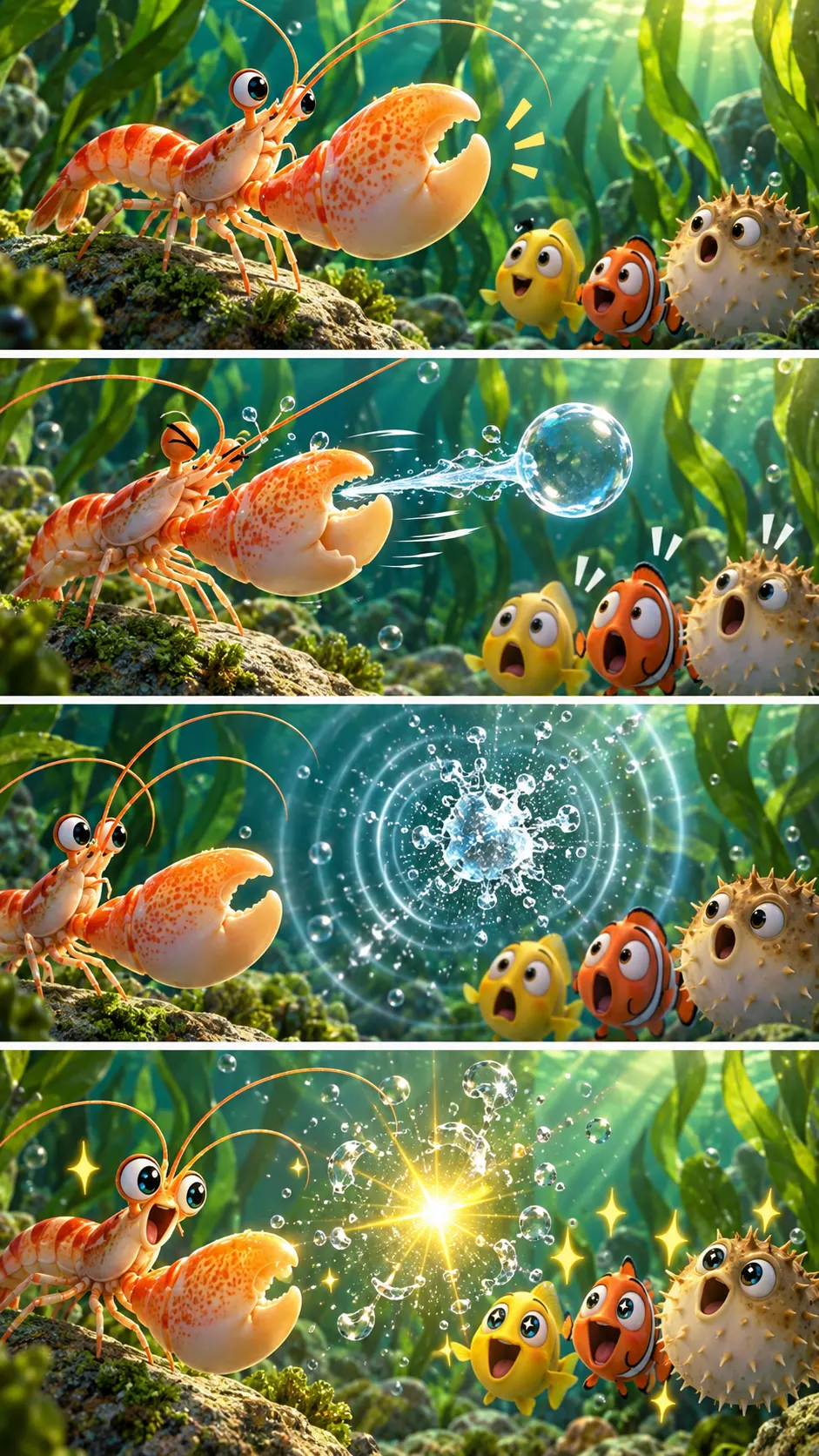
ひとことで言うとテッポウエビは、ハサミから出す水流で泡を作り、その泡がつぶれる力で獲物をしびれさせる!
暖かい海の浅瀬に潜ると、「パチパチ」「チリチリ」という、揚げ物のような音が聞こえることがあります。
その音の主の一つが、体長数cmのテッポウエビ。片方のハサミだけが体に比べて大きく、それを閉じると、驚くほど大きな「バチン!」という音が出ます。英語では「ピストルシュリンプ(拳銃エビ)」と呼ばれるほどです。
長いあいだ、この音は「ハサミの先どうしが勢いよくぶつかる音」だと考えられてきました。ところが2000年、物理学者たちがその常識をひっくり返します。
01犯人はハサミではなく「泡」だった
オランダ・トゥウェンテ大学のミシェル・フェルスライスさんとデトレフ・ローゼさんたちは、テッポウエビのハサミが閉じる様子を超高速カメラで撮影し、同時に水中マイクで音を記録しました。
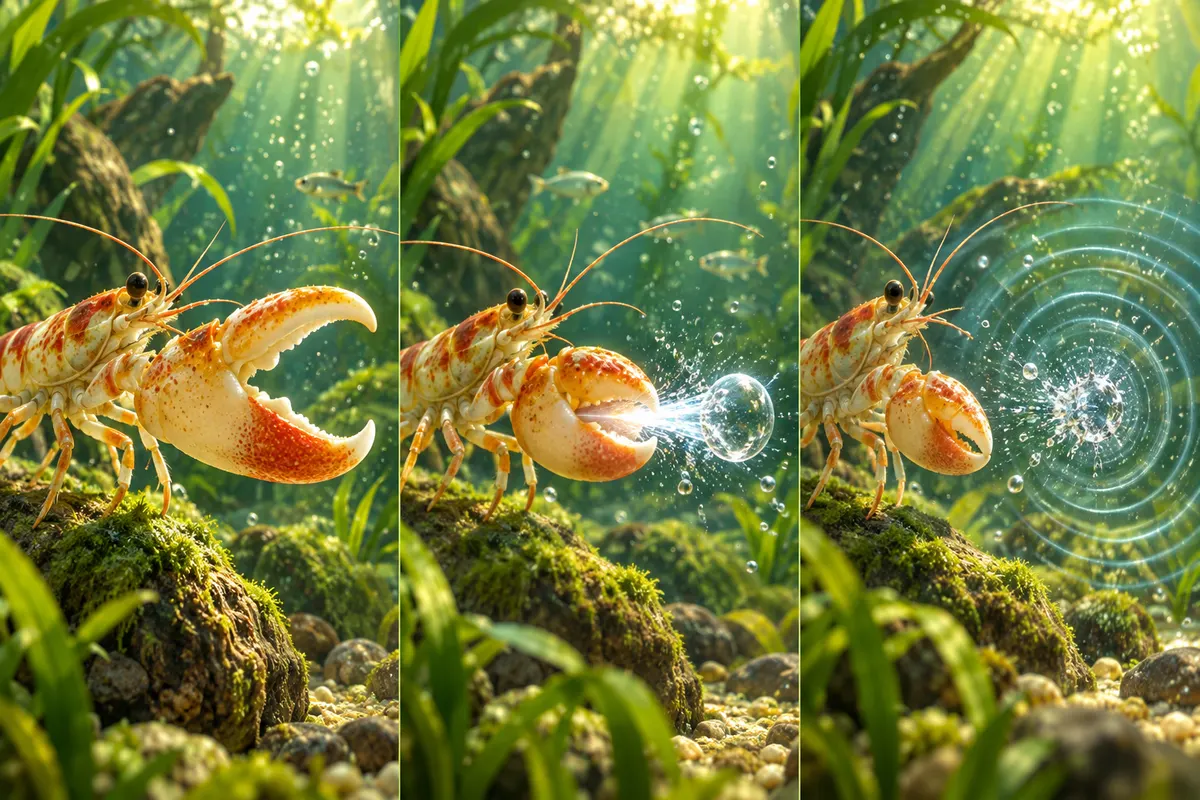
ハサミには、片側に出っ張り(プランジャー)、反対側にくぼみがあります。ハサミが閉じると、出っ張りがくぼみに入り込み、中の水をピストンのように一気に押し出します。これが「水鉄砲」の正体です。
泡がつぶれるときに生まれる強い圧力の波は、近くの小魚やエビをしびれさせることがあります。テッポウエビは、泡を弾丸にした狩りをしているのです。
02つぶれる泡は、一瞬だけ光っていた
話はここで終わりません。翌2001年、同じチームは『Nature』に、さらに驚く報告を出しました。
泡がつぶれる瞬間、ごく短い光が出ていたのです。光の性質から、泡の中は少なくとも約5000ケルビン(太陽の表面に近い温度)という、とんでもない高温・高圧になっていると考えられました。
研究チームはこれを、超音波で泡を光らせる現象「ソノルミネッセンス」にちなんで、シュリンポルミネッセンス(エビ発光)と名づけました。ただし光はとても弱く、人の目で見えるものではありません。高温も一瞬だけの、泡の中だけの話です。
03海の中の「騒音王」
テッポウエビの音は、海の騒音としても知られています。
ハワイのカネオヘ湾でテッポウエビの仲間40匹の音を測った研究(Au & Banks, 1998)では、1m離れた場所での音の強さが183〜189デシベル(水中での基準)に達しました。単純に空気中の音と比べることはできませんが、海の中ではとても大きな音です。
テッポウエビが群れでいる浅い海では、このパチパチ音が昼も夜も鳴り続け、人間が使う水中の音響機器の邪魔になることもあります。
04まとめ
ハサミの音だと思われていたテッポウエビの「バチン!」は、実は泡がつぶれる音でした。しかもその泡は、一瞬だけ太陽の表面のような高温になって光っていた。
小さなエビが、物理学者もうなる「泡の兵器」を使いこなしている。海の中のパチパチ音が、少し違って聞こえてきませんか?
この研究を英語で読もう原田英語の English CornerSnapping shrimp are small animals, but the snap of their large claw is surprisingly loud. 音声
音声 4択クイズ9問A2・B1・B2タップして開く
原田英語の English Corner
この研究を英語で読もう
The snapping shrimp is only a few centimeters long, but it makes a very loud sound. It has one big claw. For a long time, people thought the sound came from the claw hitting itself.
In 2000, scientists used a very fast camera to check. When the claw closes, it shoots out a fast jet of water. This makes a bubble. The loud sound does not come when the claw closes. It comes when the bubble breaks.
77 words ・ CEFR A2
和訳を見る
テッポウエビは体長が数センチしかありませんが、とても大きな音を出します。大きなハサミが1つあります。長いあいだ、人々はその音はハサミ同士がぶつかって出ると思っていました。
2000年、科学者たちはとても速いカメラを使って確かめました。ハサミが閉じると、速い水の噴流が飛び出します。これが泡を作ります。大きな音は、ハサミが閉じるときではなく、泡がつぶれるときに出るのです。
4択リーディングクイズ
Q1. What is the passage mainly about?
テッポウエビの大きな音の正体(泡がつぶれる音)が全体のテーマなので D。
Q2. What happens when the claw closes?
When the claw closes, it shoots out a fast jet of water. とあるので A。
Q3. In this passage, "the bubble breaks" means the bubble ...
break はここでは泡が「割れて消える」こと。急につぶれて消える、という意味なので C。
Snapping shrimp are small animals, but the snap of their large claw is surprisingly loud. People long believed the noise was made when the two parts of the claw hit each other. In 2000, researchers at the University of Twente in the Netherlands filmed the claw with a high-speed camera while recording the sound underwater. They found that closing the claw pushes out a very fast jet of water.
The pressure inside the jet drops so quickly that a bubble forms. The sound was produced when this bubble collapsed, not when the claw shut. The pressure wave from the collapsing bubble can stun tiny fish, so the shrimp is actually hunting with a bubble instead of a bullet.
118 words ・ CEFR B1
和訳を見る
テッポウエビは小さな動物ですが、大きなハサミを鳴らす音は驚くほど大きいものです。人々は長いあいだ、その音はハサミの2つの部分がぶつかるときに出ると信じていました。2000年、オランダのトゥウェンテ大学の研究者たちは、水中で音を録音しながら、高速カメラでハサミを撮影しました。その結果、ハサミを閉じるととても速い水の噴流が押し出されることがわかりました。
噴流の中の圧力が急激に下がるため、泡ができます。音が出たのは、ハサミが閉じたときではなく、この泡がつぶれたときでした。つぶれる泡から出る圧力の波は小魚をしびれさせることがあるので、このエビは実は弾丸の代わりに泡で狩りをしているのです。
4択リーディングクイズ
Q1. What did the researchers do in 2000?
filmed the claw with a high-speed camera while recording the sound underwater とあるので B。
Q2. According to the passage, why does a bubble form?
The pressure inside the jet drops so quickly that a bubble forms. とあるので D。
Q3. What does the writer mean by "hunting with a bubble instead of a bullet"?
泡がつぶれる圧力の波で小魚をしびれさせる=泡が武器の役割をする、という比喩なので C。
The snapping shrimp, sometimes called the pistol shrimp, produces one of the loudest sounds in the shallow sea, yet the source of that sound was misunderstood for decades. It was assumed to be the impact of the claw's two tips. In 2000, a team including Michel Versluis and Detlef Lohse synchronized high-speed video with hydrophone recordings and showed that the acoustic pulse matched not the closure of the claw but the collapse of a cavitation bubble.
A plunger on one side of the claw fits into a socket on the other, forcing out a jet so fast that the local pressure falls and a bubble appears. A year later, the same group reported that the collapsing bubble emits a brief flash of light, suggesting temperatures of at least about 5,000 kelvin inside it. However, these findings should not be exaggerated. The light is far too faint for human eyes, the extreme heat lasts only an instant within the bubble, and the flash probably has no ecological function. Even so, the work shows how a tiny animal exploits physics that engineers still study.
182 words ・ CEFR B2
和訳を見る
テッポウエビは、ピストルシュリンプと呼ばれることもあり、浅い海で最も大きな音の一つを出しますが、その音の出どころは何十年も誤解されていました。ハサミの2つの先端がぶつかる衝撃だと思われていたのです。2000年、ミシェル・フェルスライスさんとデトレフ・ローゼさんを含むチームは、高速度映像と水中マイクの記録を同期させ、音のパルスがハサミの閉鎖ではなく、キャビテーション気泡の崩壊と一致することを示しました。
ハサミの片側にある出っ張りがもう片側のくぼみにはまり込み、非常に速い噴流を押し出すため、その場の圧力が下がって泡が現れるのです。1年後、同じグループは、つぶれる泡が短い閃光を発しており、泡の中が少なくとも約5000ケルビンに達していることを示唆すると報告しました。ただし、これらの発見を誇張すべきではありません。光は人間の目には弱すぎて見えず、極端な高温は泡の中で一瞬続くだけで、閃光にはおそらく生態学的な役割はありません。それでも、この研究は、小さな動物が技術者たちが今も研究している物理現象をいかに利用しているかを示しています。
4択リーディングクイズ
Q1. What was the main discovery of the 2000 study?
音のパルスが the collapse of a cavitation bubble と一致したと述べているので A。
Q2. Which statement about the flash of light is supported by the passage?
The light is far too faint for human eyes とあるので B。高温も泡の中で一瞬だけ。
Q3. Why does the writer say the findings "should not be exaggerated"?
直後に、光は弱い・高温は一瞬・生態的な役割はおそらくない、と理由が並ぶので D。
重要単語
- clawB1名詞(カニ・エビの)はさみ、かぎ爪The shrimp has one claw much bigger than the other.
 猫や鳥の「かぎ爪」も claw。人の爪は nail と区別する。
 - jetB1名詞噴流、噴出A fast jet of water shoots out of the claw. a jet of water「水の噴流」。ジェット機の jet も「噴き出す空気」から来ている。
- collapseB2動詞・名詞つぶれる、崩壊(する)The bubble collapses in less than a millisecond. 建物の倒壊・経済の崩壊・人が倒れるにも使う多義語。col-(共に)+lapse(滑り落ちる)。
- stunC1動詞気絶させる、しびれさせるThe shock wave can stun small fish. 「唖然とさせる」の意味もあり、stunning は「驚くほど美しい」。stun gun は「スタンガン」。
- luminescenceC1名詞発光The flash was named shrimpoluminescence. lumin-(光)は illuminate「照らす」と同じ語根。bioluminescence は「生物発光」。
- exaggerateB2動詞誇張するWe should not exaggerate the results of a single study. g が2つ続くつづりに注意。名詞は exaggeration。入試の内容一致で頻出。
 入試に出る順の単語帳を印刷する →
 全5561語の「科学英単語カード」で復習する →
 動画でもっと知る
動画は各チャンネルの公式埋め込みで表示しています(YouTube)。
 4コマでわかる
このネタ、誰かに教えたくなった?
テッポウエビの「バチン!」という爆音、ハサミ同士がぶつかる音だと思ってたら違った。ハサミから出た水の勢いで泡ができて、それがつぶれる音らしい。しかもつぶれる瞬間、泡の中は数千度になって一瞬光る。
押すと「マジかリスト」に保存されます
 出典・参考文献(3件)タップで表示
- Au & Banks (1998) The acoustics of the snapping shrimp Synalpheus parneomeris in Kaneohe Bay, The Journal of the Acoustical Society of Americadoi.org
- Versluis et al. (2000) How Snapping Shrimp Snap: Through Cavitating Bubbles, Sciencedoi.org
- Lohse, Schmitz & Versluis (2001) Snapping shrimp make flashing bubbles, Naturedoi.org

※本記事は上記の研究・公開資料をもとに、原田英語が独自の言葉で解説したものです。引用は著作権法第32条の範囲で行い、出典を明記しています。画像はすべてオリジナルのイメージです。研究結果には限界や個人差があります。誤りのご指摘は原田英語のお問い合わせフォームから。
 これも「マジか!?」
 動物・植物
動物・植物
【イグノーベル賞】「ネコは液体か?」を物理学者が大真面目に論文にしていた
 動物・植物
動物・植物
シャコのパンチは「1発で2回」当たっていた。2発目の正体は水の中で潰れる泡
 動物・植物
動物・植物
ペンギンにも「ひざ」がある。極寒を乗り切る“おしくらまんじゅう”は30〜60秒ごとに全員で一歩
 動物・植物
動物・植物
つるはなぜクルクル巻く? キュウリの巻きひげは「途中で逆巻き」していた
 動物・植物
動物・植物
虫が「道具」でハチを釣っていた。ハチの樹脂を前脚に塗る“釣り師”サシガメの作戦

 動物・植物
動物・植物