

 動物・植物ホント
ボノボは鳴き声を「単語」のように組み合わせていた。言葉のルーツは700万年前?
 2026.10.02
 English Corner(A2〜B2・4択クイズ)
 読む前に予想してみよう!
ボノボの鳴き声の組み合わせは、単純に意味を足し算しただけのものしか見つからなかった
一方の鳴き声がもう一方の意味を変える、より複雑な組み合わせも3つ見つかった。
 研究カード(どんな研究?)
- 対象
- コンゴ民主共和国の野生ボノボ
- 規模
- 1地域の群れの鳴き声記録
- 研究の種類
- 野外観察(分布意味論による分析)
- 確かさ
- ★★★☆☆
野生のボノボの鳴き声を言語学の手法で分析すると、鳴き声を組み合わせて新しい意味を作る「合成性」が広く見られ、人間の言葉に近い複雑な組み合わせもあった。
ひとことで言うとボノボは鳴き声を組み合わせて、新しい意味を作っていた!
「青い」と「空」をくっつければ「青い空」。人間の言葉は、小さな意味のパーツを組み合わせて、もっと大きな意味を作ることができます。これを言語学では「合成性」と呼びます。
長い間、この能力は人間だけの特別なものだと考えられてきました。
ところが2025年、スイスとアメリカの研究チームが、私たちに最も近い親戚のひとつボノボの鳴き声に、この合成性がたくさん隠れていることを明らかにしました。
01ボノボの「辞書」を作ってみた
使ったのは、人間の言葉の研究で使われる「分布意味論」という方法。ざっくり言うと、「その言葉がどんな場面で使われるか」から、意味を数値で表すやり方です。
研究チームはこれを鳴き声に当てはめ、単独の鳴き声と、組み合わせた鳴き声の「意味」が、どう関係しているかを調べました。研究者はこれを「ボノボ辞書のようなもの」と表現しています。
02すべての鳴き声が「組み合わせ」に使われていた
分析の結果、ボノボの鳴き声はどの種類も、少なくとも1つの「意味のある組み合わせ」に使われていました。
さらに驚きなのは、組み合わせ方の種類です。
- 足し算型:「Aの意味+Bの意味」で、そのまま合わさる(例:「金髪のダンサー」=金髪で、ダンサー)
- 修飾型:一方がもう一方の意味を変える(例:「下手なダンサー」=下手な人ではなく、ダンスが下手)
後者のような複雑なタイプは、これまで動物にはないと考えられていました。ところがボノボでは、このタイプの組み合わせが3つ見つかったのです。
03言葉のルーツは700万年以上前?
これまでにも、シジュウカラなど一部の鳥やチンパンジーで、鳴き声を組み合わせる例は報告されていました。でも、ここまで鳴き声の体系全体に合成性が広がっていることを示したのは初めてです。
研究チームによると、人間とボノボの共通の祖先は、およそ700万〜1300万年前に生きていたとされます(分岐の年代には諸説あります)。研究チームは、私たちの祖先は少なくとも700万年前には、合成性を広く使っていた可能性があると述べています。
ちなみに鳥の世界でも、シジュウカラが「警戒して」という鳴き声と「集まれ」という鳴き声を決まった順番で組み合わせ、仲間がその順番どおりに反応することが、2016年に報告されています。言葉の「パーツを組み合わせる力」は、思った以上にいろいろな動物に広がっているのかもしれません。
04まとめ
言葉は、人間がある日いきなり手に入れた能力ではなく、遠い祖先から少しずつ受け継がれてきたものなのかもしれません。
森の奥で今日も交わされているボノボたちの会話。その中に、私たちの「言葉の原点」が響いているのです。
この研究を英語で読もう原田英語の English CornerHuman language is compositional: we combine small units of meaning to build larger ones. 音声
音声 4択クイズ9問A2・B1・B2タップして開く
原田英語の English Corner
この研究を英語で読もう
In human language, we can put small words together to make new meanings, like "blue" and "sky." For a long time, people thought only humans could do this. In 2025, scientists studied the calls of wild bonobos in Africa.
Bonobos are close relatives of humans. The scientists found that bonobos also put their calls together. Every type of call was used in at least one combination with a meaning. Some combinations were even similar to human phrases.
77 words ・ CEFR A2
和訳を見る
人間の言葉では、「青い」と「空」のように、小さな言葉を組み合わせて新しい意味を作ることができます。長い間、人々はこれができるのは人間だけだと考えていました。2025年、科学者たちはアフリカの野生のボノボの鳴き声を調べました。
ボノボは人間の近い親戚です。科学者たちは、ボノボも鳴き声を組み合わせていることを発見しました。どの種類の鳴き声も、少なくとも1つの意味のある組み合わせに使われていました。中には、人間の言い回しに似た組み合わせさえありました。
4択リーディングクイズ
Q1. What is the passage mainly about?
ボノボが鳴き声を組み合わせて意味を作っていたという発見が中心なので B。
Q2. Where did the bonobos in the study live?
the calls of wild bonobos in Africa とあるので A。野生のボノボなので動物園ではない。
Q3. In this passage, "put ... together" means ...
put A together は「A を組み合わせる」。言葉や鳴き声をくっつけるという意味なので D。
Human language is compositional: we combine small units of meaning to build larger ones. For many years, this ability was thought to be unique to humans. However, in 2025, researchers from Switzerland and the United States reported that wild bonobos in the Democratic Republic of the Congo do something similar. The team recorded bonobo calls and noted the situation each time, using about 300 features.
Then they applied a method from language research that works out meaning from the contexts in which words are used. They found that every type of bonobo call appeared in at least one meaningful combination. In three combinations, one call even changed the meaning of the other, much like the phrase "bad dancer" in English.
120 words ・ CEFR B1
和訳を見る
人間の言葉は「合成的」です。つまり、小さな意味の単位を組み合わせて、より大きな意味を作ります。長年、この能力は人間だけのものだと考えられてきました。しかし2025年、スイスとアメリカの研究者たちが、コンゴ民主共和国の野生のボノボも似たことをしていると報告しました。チームはボノボの鳴き声を録音し、鳴くたびにその状況を約300の項目で記録しました。
そして、言葉が使われる文脈から意味を割り出す、言語研究の方法を当てはめました。その結果、ボノボのどの種類の鳴き声も、少なくとも1つの意味のある組み合わせに現れていました。3つの組み合わせでは、英語の「bad dancer(下手なダンサー)」という言い回しのように、一方の鳴き声がもう一方の意味を変えてさえいました。
4択リーディングクイズ
Q1. What ability was once thought to be unique to humans?
we combine small units of meaning to build larger ones を this ability と受けて unique to humans とされていたので C。
Q2. How did the researchers work out the meaning of the calls?
鳴くたびに状況を記録し、a method ... that works out meaning from the contexts を使ったとあるので B。
Q3. Why does the passage mention the phrase "bad dancer"?
one call even changed the meaning of the other, much like the phrase "bad dancer" とあり、修飾型の組み合わせの例えなので A。
In the Kokolopori reserve in the Democratic Republic of the Congo, researchers from the University of Zurich and Harvard University followed wild bonobos and recorded their calls. For each call, they noted roughly 300 features of the situation. They then applied distributional semantics, a method from linguistics that represents a signal's meaning based on the contexts in which it occurs.
The results, published in Science in 2025, bear on compositionality, the ability to combine meaningful units into larger meaningful expressions. This ability has often been treated as a defining feature of human language. Every bonobo call type appeared in at least one compositional combination. Three combinations went further. In them, one element modified the meaning of the other, as "bad" does in "bad dancer," a type thought to be absent in animals.
Humans and bonobos share an ancestor thought to have lived roughly 7 to 13 million years ago, so the authors argue that compositionality may be at least 7 million years old. That argument has gaps. The meanings were inferred from context, not from how listening bonobos responded, and only one population was studied. And combining calls is one thing, while having a grammar is another.
197 words ・ CEFR B2
和訳を見る
コンゴ民主共和国のココロポリ保護区で、チューリッヒ大学とハーバード大学の研究者たちが野生のボノボを追いかけ、その鳴き声を録音しました。鳴き声ごとに、その場の状況の特徴もおよそ300項目記録しました。そのうえで、信号が現れる文脈をもとにその意味を表す言語学の手法「分布意味論」を当てはめました。
2025年に『Science』で発表されたこの結果は、意味のある単位を組み合わせて、より大きな意味のある表現を作る能力である「合成性」にかかわるものです。この能力は、しばしば人間の言語を特徴づける性質とされてきました。ボノボのすべての種類の鳴き声が、少なくとも1つの合成的な組み合わせに現れていました。3つの組み合わせはさらに進んでいました。そこでは、「bad dancer」の bad のように、一方の要素がもう一方の意味を変えていたのです。これは、動物にはないと考えられてきたタイプでした。
人間とボノボの共通祖先はおよそ700万〜1300万年前に生きていたと考えられているため、著者らは、合成性は少なくとも700万年前からあった可能性があると主張しています。この主張には穴もあります。意味は、聞いているボノボの反応からではなく状況から推測されたもので、調べたのは1つの集団だけでした。それに、鳴き声を組み合わせることと文法を持つことは別のことです。
4択リーディングクイズ
Q1. What is the main claim of the study?
the authors argue that compositionality may be at least 7 million years old が中心的な主張なので D。最終文で鳴き声の組み合わせと文法は別だと述べているので A は誤り。
Q2. What made three of the combinations especially notable?
Three combinations went further. In them, one element modified the meaning of the other とあり、動物にはないと考えられてきたタイプだったので C。
Q3. Which of the following is mentioned as a limitation of the study?
The meanings were inferred from context, not from how listening bonobos responded とあるので B。調べたのは1集団だけなので A は逆。
重要単語
- compositionalityC1名詞合成性(部分を組み合わせて意味を作る性質)Compositionality allows us to create new sentences.
 compose(組み立てる)→ composition(構成)→ compositional(合成的な)→ compositionality と派生。
 - vocalizationC1名詞発声、鳴き声Bonobos use many kinds of vocalizations. vocal(声の)+-ize+-ation。動物の「鳴き声」を学術的に言うときの定番語。
- combinationB1名詞組み合わせThis call combination has a special meaning. combine(組み合わせる)の名詞形。in combination with ~「~と組み合わせて」も頻出。
- ancestorB2名詞祖先Humans and bonobos share a common ancestor. common ancestor「共通祖先」は進化の長文の定番。反対は descendant(子孫)。
- contextB2名詞状況、文脈The meaning of a word depends on its context. in this context「この文脈では」。形容詞 contextual(文脈上の)。
- uniqueB1形容詞唯一の、特有のThis ability was once thought to be unique to humans. be unique to ~「~だけに特有の」の形が入試で頻出。uni-(1つ)は uniform, unit と同じ。
 入試に出る順の単語帳を印刷する →
 全5561語の「科学英単語カード」で復習する →
 動画でもっと知る
動画は各チャンネルの公式埋め込みで表示しています(YouTube)。
この話題を TED で聞く
同じテーマの TED・TED-Ed を、 TED HACK で。英語の見どころ・使える表現・学習ミッションつきの日本語ガイドです。(運営:原田英語)

 公式・一次情報をチェック
 4コマでわかる
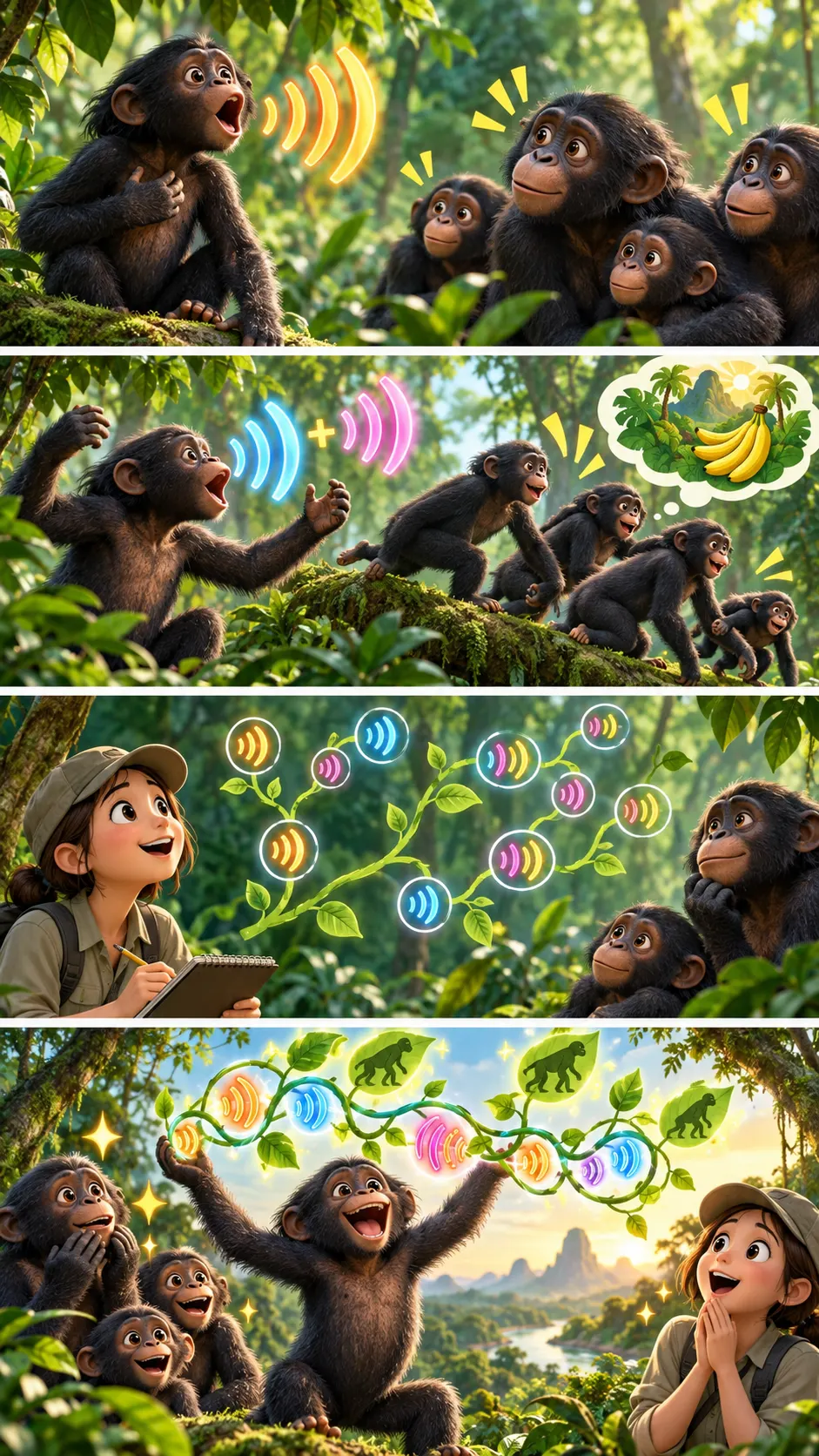
このネタ、誰かに教えたくなった?
野生のボノボの鳴き声を、言語学の手法で「辞書」にしてみたら、鳴き声を組み合わせて新しい意味を作っていたらしい。しかも一部は「下手なダンサー」のように、片方がもう片方の意味を変える人間の言葉っぽい組み合わせ。
押すと「マジかリスト」に保存されます
 出典・参考文献(3件)タップで表示
- Berthet, Surbeck & Townsend (2025) Extensive compositionality in the vocal system of bonobos, Sciencedoi.org
- Leroux et al. (2023) Call combinations and compositional processing in wild chimpanzees, Nature Communicationsdoi.org
- Suzuki, Wheatcroft & Griesser (2016) Experimental evidence for compositional syntax in bird calls, Nature Communicationsdoi.org

※本記事は上記の研究・公開資料をもとに、原田英語が独自の言葉で解説したものです。引用は著作権法第32条の範囲で行い、出典を明記しています。画像はすべてオリジナルのイメージです。研究結果には限界や個人差があります。誤りのご指摘は原田英語のお問い合わせフォームから。
 これも「マジか!?」

 動物・植物
動物・植物
天才犬は「盗み聞き」で言葉を覚える。1歳半の子どもと同じ学び方だった

 動物・植物
動物・植物
シャチは海藻で「背中の流しっこ」をしていた。クジラの仲間で初の“道具作り”
 動物・植物
動物・植物
カエルも「多すぎて選べない」。オスの声が8つになると、迷った末に決めない回数が約5倍に
 動物・植物
動物・植物
【最新研究】群れで暮らすネズミほど「耳がいい」らしい。野生の9種を比べてわかったこと
 動物・植物
動物・植物
ゾウは仲間と「声をそろえて」いた。AIが数十年にわたる録音から合唱を聞き分けた
 動物・植物
動物・植物