

 語学・英語学習ホント
赤ちゃんは「世界中の言語の音」を聞き分けていた。1歳ごろまでに弱まる“耳の超能力”
 2026.10.02
 English Corner(A2〜B2・4択クイズ)
 読む前に予想してみよう!
日本の赤ちゃんは、生まれつき英語のrとlを聞き分けられない
生後6〜8か月ではアメリカの赤ちゃんと同じくらい聞き分けられ、10〜12か月で差が開く。
 研究カード(どんな研究?)
- 対象
- 生後6〜12か月の乳児(日米)
- 規模
- 数十人規模の実験を複数
- 研究の種類
- 実験研究(行動指標)
- 確かさ
- ★★★★☆
生後半年ごろの赤ちゃんは外国語の音の違いも聞き分けられる。でも1歳に近づくと母語に特化し、使わない区別は苦手になっていく。
ひとことで言うと赤ちゃんの耳はどの国の言葉の音もキャッチできる!
「日本人はrとlの区別が苦手」。英語を勉強していると、一度は耳にする話ですよね。
でも実は、生後6〜8か月の日本の赤ちゃんは、rとlをアメリカの赤ちゃんと同じくらい聞き分けていたとしたら?
赤ちゃんの耳は、生まれてしばらくの間、世界中の言語の音の違いをキャッチできる「万能アンテナ」のような状態にあることが、数十年にわたる研究でわかってきました。
01生後6か月の赤ちゃんは「世界市民」
この分野の代表的な研究が、カナダの心理学者ワーカーとティーズの1984年の研究です。
赤ちゃんは、自分の家で使われていない言語の音まで区別できる。でも1歳に近づくと、その力がしぼんでいくのです。
02日本の赤ちゃんとrとl
では日本語ではどうでしょう。ワシントン大学のパトリシア・クールらは2006年、アメリカと日本の赤ちゃんに英語のrとlを聞かせる実験を報告しました。
結果は、まさに「マジか」。生後6〜8か月では、日米の赤ちゃんの聞き分け成績に大きな差はありませんでした。ところが10〜12か月になると、アメリカの赤ちゃんは聞き分けが上手になり、日本の赤ちゃんは下がっていたのです。
つまり「rとlが苦手」は生まれつきではなく、日本語の環境に耳が最適化された結果だと考えられます。
03カギは「生身の人」だった
クールらはさらに、2003年の研究で面白いことを確かめています。英語環境で育つ生後9か月の赤ちゃんに、中国語(標準中国語)を話す大人が遊びながら話しかけるセッションを12回行いました。
すると、その赤ちゃんたちは英語だけを聞いた子に比べて、中国語の音の区別を保っていました。ところが同じ内容をビデオや音声だけで見聞きした赤ちゃんには、効果が見られなかったのです。
少なくとも乳児期の音の学習では、画面より目の前でやりとりする人が大きな役割を果たしているようです。
04「失われた」のではなく「最適化された」
ここで大事なのは、赤ちゃんの変化が能力の「劣化」ではないということ。クールらの研究では、母語の音の聞き分けはむしろ伸びていました。
脳は、毎日よく聞く音を素早く正確に処理できるよう、限られたリソースを振り分けているのです。その代わり、使わない区別には反応しにくくなります。
こうした「耳の最適化」は母音でも起こり、子音より少し早い生後6か月ごろから、母語の影響が見え始めることが知られています。
05まとめ
赤ちゃんは、生後半年ごろにはどの言語の音でも聞き分けられる耳を持っています。そして1年ほどで、自分の周りの言語に合わせて耳をチューニングしていきます。
大人になった私たちの「聞き取れない」も、才能ではなく耳のチューニングの問題。チューニングは、練習でかけ直すことができます。
この研究を英語で読もう原田英語の English CornerYoung babies seem to have ears that can catch sound differences from almost any language. 音声
音声 4択クイズ9問A2・B1・B2タップして開く
原田英語の English Corner
この研究を英語で読もう
Many Japanese people find it hard to hear English R and L. But babies are different. At six to eight months old, Japanese and American babies could hear the difference between R and L equally well.
By ten to twelve months, American babies got better, but Japanese babies got worse. Their ears became tuned to Japanese. So this problem is not something we are born with. Adults can still practice with word pairs like "right" and "light."
77 words ・ CEFR A2
和訳を見る
多くの日本人は英語のRとLを聞き分けるのが難しいと感じます。しかし赤ちゃんは違います。
生後6〜8か月のとき、日本とアメリカの赤ちゃんはRとLの違いを同じくらいよく聞き分けられました。10〜12か月になると、アメリカの赤ちゃんは上手になりましたが、日本の赤ちゃんは下手になりました。彼らの耳が日本語に合わせて調整されたのです。ですから、この苦手さは生まれつきのものではありません。大人でも right と light のような単語のペアで練習することができます。
4択リーディングクイズ
Q1. What is the passage mainly about?
赤ちゃんのRとLの聞き分けが1歳前後で変わる、という内容なので B。
Q2. What happened to Japanese babies by ten to twelve months?
American babies got better, but Japanese babies got worse とあるので C。
Q3. In this passage, "tuned to Japanese" means the babies' ears ...
tune は楽器などを「調整する」。耳が日本語の音に合わせて調整された=日本語の音に強くなった、なので D。
Young babies seem to have ears that can catch sound differences from almost any language. In a famous 1984 study, Canadian researchers played sounds from Hindi and a Native American language to babies growing up with English. Many six- to eight-month-olds could hear the differences, but by ten to twelve months most of them could not.
Later, Patricia Kuhl and her team compared American and Japanese babies listening to English R and L. At first, both groups did about equally well. By around their first birthday, the American babies had improved, while the Japanese babies had declined. Kuhl also found that babies learned Chinese sounds from a real person who played with them, but not from a video or audio recording of the same sessions.
125 words ・ CEFR B1
和訳を見る
幼い赤ちゃんは、ほぼどの言語の音の違いでもキャッチできる耳を持っているようです。1984年の有名な研究で、カナダの研究者たちは、英語を聞いて育つ赤ちゃんにヒンディー語と北米先住民の言語の音を聞かせました。生後6〜8か月の赤ちゃんの多くはその違いを聞き分けられましたが、10〜12か月になるとほとんどが聞き分けられなくなっていました。その後、パトリシア・クールらのチームは、英語のRとLを聞くアメリカと日本の赤ちゃんを比べました。
最初は、どちらのグループもほぼ同じくらいよくできました。1歳の誕生日ごろには、アメリカの赤ちゃんは上達し、日本の赤ちゃんは成績が下がっていました。クールはまた、赤ちゃんが一緒に遊んでくれる生身の人からは中国語の音を学んだのに、同じセッションのビデオや音声の録音からは学ばなかったことも発見しました。
4択リーディングクイズ
Q1. What did the 1984 study find?
Many six- to eight-month-olds could hear the differences, but by ten to twelve months most of them could not とあるので B。
Q2. From what did babies learn Chinese sounds?
learned Chinese sounds from a real person ... but not from a video or audio recording とあるので C。
Q3. What can we infer from the passage?
最初は同じでも、聞く言語によって1歳ごろに差が出ることから、経験が聞き取れる音を形作ると推論できるので D。
In a landmark 1984 study, Werker and Tees tested English-learning infants on consonant contrasts from Hindi and a Native American language. At six to eight months, many of the babies could discriminate the sounds. By ten to twelve months, most could not, and English-speaking adults also struggled with them. Results like these led researchers to describe young babies as "citizens of the world."
Kuhl and colleagues later found the same pattern with a contrast that is famously hard for Japanese speakers, English R and L. At six to eight months, American and Japanese infants performed about equally. By ten to twelve months, the American infants had improved and the Japanese infants had declined.
So "tuning" is a better word for this than "loss," because perception of native sounds actually becomes sharper. In another experiment, nine-month-old American infants had twelve play sessions with a live Mandarin speaker and kept their sensitivity to Mandarin sounds. Infants who watched the same material on video did not. These are group averages, and individual babies vary widely. The ability does not vanish completely, either. With training, adults can still improve their perception of non-native contrasts.
190 words ・ CEFR B2
和訳を見る
1984年の画期的な研究で、ワーカーとティーズは、英語を習得中の乳児に、ヒンディー語と北米先住民の言語の子音の対立を聞かせて調べました。生後6〜8か月では、多くの赤ちゃんがそれらの音を聞き分けられました。10〜12か月になると、ほとんどができなくなっており、英語を話す大人もそれらの音に苦労しました。こうした結果から、研究者たちは幼い赤ちゃんを「世界市民」と表現するようになりました。クールらはその後、日本語話者にとって難しいことで有名な対立、英語のRとLでも同じパターンを見出しました。
6〜8か月では、アメリカと日本の乳児の成績はほぼ同じでした。10〜12か月になると、アメリカの乳児は上達し、日本の乳児は低下していました。
ですから、これは「喪失」よりも「調整」と呼ぶほうがふさわしいのです。母語の音の知覚はむしろ鋭くなるからです。別の実験では、生後9か月のアメリカの乳児が、生身の中国語話者と12回遊ぶセッションを受け、中国語の音への感受性を保ちました。同じ内容をビデオで見た乳児は保てませんでした。これらは集団の平均であり、赤ちゃん一人ひとりの差は大きいものです。また、その能力が完全に消えるわけでもありません。大人でも訓練によって、母語にない対立の知覚を改善できるのです。
4択リーディングクイズ
Q1. Why does the author prefer the word "tuning" to "loss"?
because perception of native sounds actually becomes sharper と理由が述べられているので A。
Q2. What did the experiment with Mandarin show?
twelve play sessions with a live Mandarin speaker で感受性が保たれ、Infants who watched the same material on video did not. とあるので C。
Q3. Which statement would the author most likely agree with?
最終文 With training, adults can still improve their perception of non-native contrasts. と一致するので D。
重要単語
- discriminateC1動詞見分ける・区別するBabies can discriminate sounds that adults miss.
 discriminate between A and B「AとBを区別する」。discriminate against ~ だと「~を差別する」になる。前置詞で意味が変わる入試頻出語。
 - perceptionB2名詞知覚・とらえ方Our perception of sounds changes with experience. 動詞 perceive。speech perception「音声知覚」はリスニング研究の基本用語。
- contrastB2名詞(音などの)対立・違いThe R-L contrast is hard for many learners. 音声学では「意味を区別する音の違い」。right / light のような minimal pair(最小対)で練習するのが定番。
- infantB2名詞乳児・赤ちゃんThe infant turned toward the new sound. ラテン語 in-(否定)+fans(話す)=「まだ話せない者」が語源。infancy「乳児期」。
- native languageB1名詞(句)母語Your native language shapes how you hear. first language(L1)とも言う。SLAでは学ぶ言語を L2、母語を L1 と書くのが一般的。
- sensitivityB2名詞感受性・敏感さInfants show high sensitivity to speech sounds. sensitive to ~「~に敏感な」の名詞形。sensible(分別のある)との混同に注意。
- declineB2動詞・名詞低下する・低下Their ability to hear the contrast declined. グラフ問題の頻出語。decline an offer「申し出を断る」の意味もある。
 入試に出る順の単語帳を印刷する →
 全5561語の「科学英単語カード」で復習する →
 動画でもっと知る
動画は各チャンネルの公式埋め込みで表示しています(YouTube)。
この話題を TED で聞く
同じテーマの TED・TED-Ed を、 TED HACK で。英語の見どころ・使える表現・学習ミッションつきの日本語ガイドです。(運営:原田英語)

 公式・一次情報をチェック
 4コマでわかる
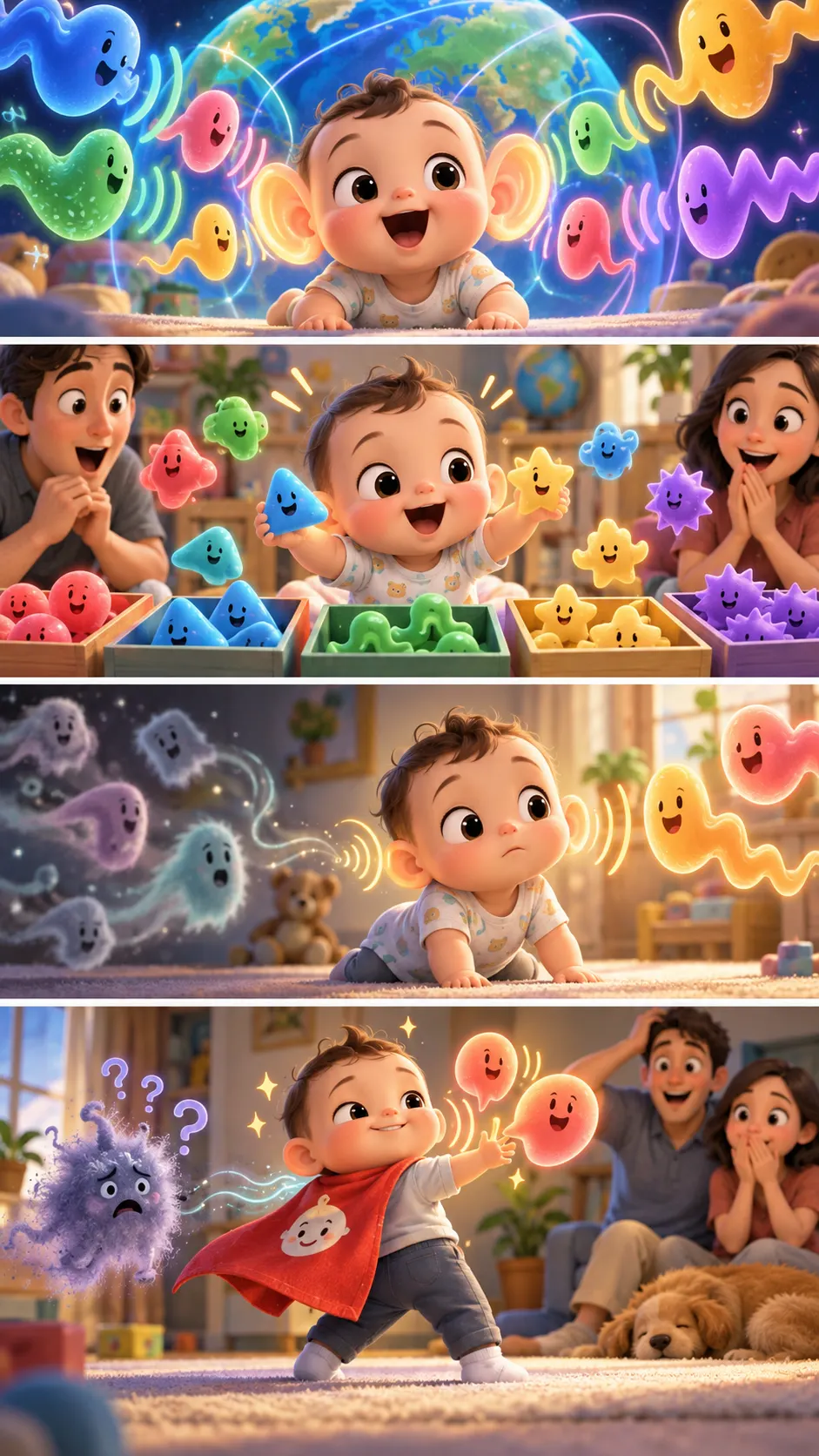
このネタ、誰かに教えたくなった?
生後6〜8か月の日本の赤ちゃんは英語のrとlをちゃんと聞き分けていたらしい。それが1歳前には苦手になる。「日本人はrとlが苦手」は生まれつきじゃなかった。
押すと「マジかリスト」に保存されます
 出典・参考文献(4件)タップで表示
- Werker & Tees (1984) Cross-language speech perception: Evidence for perceptual reorganization during the first year of life. Infant Behavior and Developmentdoi.org
- Kuhl et al. (2006) Infants show a facilitation effect for native language phonetic perception between 6 and 12 months. Developmental Sciencedoi.org
- Kuhl, Tsao & Liu (2003) Foreign-language experience in infancy: Effects of short-term exposure and social interaction on phonetic learning. PNASdoi.org
- Kuhl (2004) Early language acquisition: cracking the speech code. Nature Reviews Neurosciencedoi.org

※本記事は上記の研究・公開資料をもとに、原田英語が独自の言葉で解説したものです。引用は著作権法第32条の範囲で行い、出典を明記しています。画像はすべてオリジナルのイメージです。研究結果には限界や個人差があります。誤りのご指摘は原田英語のお問い合わせフォームから。
 これも「マジか!?」


 語学
語学
「大人はLとRを聞き分けられない」はウソ。日本人で実証された"いろんな声"トレーニング

 語学
語学
日本人の耳には「存在しない母音」が聞こえていた。カタカナ英語の背景にある「耳の錯覚」

 語学
語学
英語は「口元を見る」と聞き取れる? 日本人は静かな場所だと唇の情報をあまり使わないという研究があった
 語学
語学
英語は「ダダダ」、日本語は「タタタ」。リズムの違いを測ったら、教科書の説明は半分ウソだった
 語学
語学
シャドーイング、効くのは"話す力"より"聞く耳"だった? 研究で見えた実力と限界

 語学
語学