語学・英語学習ウソ
「聞き流すだけで話せる」は本当? 赤ちゃんですら録画からは学べなかった実験
 2026.10.02
 English Corner(A2〜B2・4択クイズ)
 読む前に予想してみよう!
赤ちゃんは、外国語のビデオを見せるだけでもその言語の音を聞き分けられるようになる
生身の人との関わりがあると学べたが、同じ内容のビデオや音声だけでは学習効果が見られなかった。
 研究カード(どんな研究?)
- 対象
- アメリカの生後9か月の赤ちゃん
- 規模
- 数十人
- 研究の種類
- 実験(生の対話・ビデオ・音声の条件比較)
- 確かさ
- ★★★☆☆
意味のわからない英語を流しておくだけで話せるようになる、という証拠はない。赤ちゃんでさえ、録画の外国語からは音の聞き分けを学べなかった。
ひとことで言うと聞き流すだけでは話せない。「わかる英語」を「注意して」聞こう!
「英語を流しっぱなしにするだけで、ある日突然しゃべれるようになる」。忙しい大人にとって、こんなに魅力的な話はありません。
赤ちゃんだって、周りの言葉を聞いているうちに話せるようになる。だから大人も、聞いていればいつか話せるはず——。そう考えたくなりますよね。
ところが、その赤ちゃん自身が、「録画や録音をただ聞かせるだけ」では学べなかったという有名な実験があります。
01赤ちゃんは「ビデオの中国語」から学べなかった
言葉を吸収する天才のはずの赤ちゃんでさえ、画面やスピーカーから流れてくるだけの言葉からは、音を学べなかったのです。
研究チームは、人との関わりが赤ちゃんの注意や意欲を高めることが、学習のスイッチになると考えています。
02大人の脳は「気づかないもの」を覚えにくい
大人の外国語学習でも、似たことが言われています。第二言語習得の研究者リチャード・シュミットは、1990年の論文で、学習者が意識して「気づいた」ものが身につくという考え方(気づき仮説)を提案しました。
BGMのように英語を流していると、脳はそれを「意味のない雑音」として処理してしまいがちです。
実際、英語の音声を聞くだけで新しい単語がどれだけ身につくかを調べた研究では、聞くだけで覚えられる単語は、限られていることがわかっています。

03「聞き流し」が役立つ、ただ一つの使い方
では、聞き流しはまったくのムダなのか。実は、そうとも言い切れません。
外国語の音の区別を学ぶ実験で、集中して練習する時間と、練習せずにその音をただ聞く時間を交互に組み合わせると、練習だけを続けたときと同じくらい学習が進んだという報告があります。
ポイントは、先にしっかり練習していること。ゼロから聞き流すのではなく、「一度ちゃんと学んだ英語を、すきま時間に流して復習する」なら、聞き流しにも意味がありそうです。
04まとめ
英語は「BGM」にしているうちは、なかなか身につきません。
大切なのは、わかる英語を、注意して聞き、自分でも使ってみること。聞き流しは、その後の「おかわり復習」として使えば、ちゃんと味方になってくれます。
この研究を英語で読もう原田英語の English CornerCan you learn English just by playing it in the background while you cook or drive? 音声
音声 4択クイズ9問A2・B1・B2タップして開く
原田英語の English Corner
この研究を英語で読もう
Some people say you can learn English just by playing it in the background. But is that true? In a famous study, nine-month-old American babies heard Chinese twelve times. Some babies played with a Chinese speaker. They learned new Chinese sounds.
Other babies watched the same person on video or heard only the audio. They learned nothing. So listen to English you can understand, pay attention, and try to use it yourself.
72 words ・ CEFR A2
和訳を見る
英語をBGMのように流しておくだけで学べると言う人がいます。でも、それは本当でしょうか。ある有名な研究で、生後9か月のアメリカの赤ちゃんが中国語を12回聞きました。中国語を話す人と遊んだ赤ちゃんもいました。その赤ちゃんたちは中国語の新しい音を学びました。
ほかの赤ちゃんは同じ人をビデオで見たり、音声だけを聞いたりしました。その赤ちゃんたちは何も学びませんでした。ですから、理解できる英語を、注意して聞き、自分でも使ってみましょう。
4択リーディングクイズ
Q1. Which babies learned new Chinese sounds?
Some babies played with a Chinese speaker. They learned new Chinese sounds. とあるので C。
Q2. How many times did the babies hear Chinese?
heard Chinese twelve times とあるので A。9 は赤ちゃんの月齢。
Q3. What does the writer suggest?
listen to English you can understand, pay attention, and try to use it yourself とあるので D。
Can you learn English just by playing it in the background while you cook or drive? A famous 2003 study suggests that even babies cannot learn this way.
Researchers gave nine-month-old American babies twelve sessions of Mandarin Chinese. Some babies played with a live Chinese speaker. They learned to tell apart Chinese sounds almost as well as babies growing up in Taiwan. Other babies watched the same person on video or heard only the audio. They learned nothing.
For adults, the researcher Richard Schmidt argued that we learn what we notice. English that we do not pay attention to may simply become noise. Background listening does have one use. After focused practice, hearing the same sounds again may support learning.
120 words ・ CEFR B1
和訳を見る
料理や運転をしながら英語をBGMとして流しておくだけで、英語は身につくのでしょうか。2003年の有名な研究は、赤ちゃんでさえこの方法では学べないことを示しています。
研究者たちは、生後9か月のアメリカの赤ちゃんに、標準中国語に触れるセッションを12回行いました。生身の中国語話者と遊んだ赤ちゃんもいました。その赤ちゃんたちは、台湾で育つ赤ちゃんとほぼ同じくらい中国語の音を聞き分けられるようになりました。ほかの赤ちゃんは、同じ人をビデオで見たり、音声だけを聞いたりしました。その赤ちゃんたちは何も学びませんでした。
大人については、研究者のリチャード・シュミットが、人は気づいたものを学ぶと主張しました。注意を向けない英語は、単なる雑音になってしまうかもしれません。それでも、聞き流しにも1つ使い道があります。集中して練習した後に同じ音をもう一度聞くと、学習の助けになるかもしれないのです。
4択リーディングクイズ
Q1. How well did babies who played with a live speaker learn?
They learned to tell apart Chinese sounds almost as well as babies growing up in Taiwan. とあるので B。
Q2. What did Richard Schmidt argue?
Richard Schmidt argued that we learn what we notice とあるので A。
Q3. When can background listening be useful, according to the passage?
After focused practice, hearing the same sounds again may support learning. とあるので C。
Leave a language playing in the background and you will pick it up, or so the hope goes, since babies seem to learn that way. A well-known experiment points the other way. In 2003, Kuhl and colleagues gave nine-month-old American infants twelve sessions of exposure to Mandarin.
Some infants spent the sessions with a live speaker who read and played with them. They learned to discriminate a Mandarin sound contrast about as well as infants raised in Taiwan. Others saw the same speaker on video or heard only the audio, and they showed no learning at all.
The researchers proposed that social interaction raises attention and motivation, which switches learning on. The study tested infant perception, and adult speaking ability is a different skill. It undercuts the claim that passive exposure is enough.
In adult research, Schmidt's noticing hypothesis holds that learners acquire what they consciously attend to, and studies of vocabulary learning through listening show that only some new words are picked up this way. Background listening keeps a narrow role. In sound-learning experiments, alternating active practice with periods of passive exposure enhanced learning. That makes background audio most useful for reviewing material already studied with full attention.
199 words ・ CEFR B2
和訳を見る
言語を背景に流しておけば身につく。少なくともそう期待されています。赤ちゃんはそうやって学んでいるように見えるからです。
しかし、ある有名な実験は逆の方向を示しています。2003年、クールらは生後9か月のアメリカの乳児に、標準中国語に触れるセッションを12回行いました。一部の乳児は、本を読んだり一緒に遊んだりしてくれる生身の話し手とセッションを過ごしました。この乳児たちは、中国語の音の対立を、台湾で育った乳児とほぼ同じくらい聞き分けられるようになりました。
ほかの乳児は同じ話し手をビデオで見たり、音声だけを聞いたりしましたが、学習はまったく見られませんでした。研究者たちは、社会的なやりとりが注意と意欲を高め、それが学習のスイッチを入れるのだと考えました。この研究が調べたのは乳児の知覚であり、大人の話す力はまた別の技能です。
それでも、受け身の接触で十分だという主張は揺らぎます。大人を対象とした研究では、シュミットの気づき仮説は、学習者は意識的に注意を向けたものを習得すると主張しており、リスニングによる語彙学習の研究は、この方法で身につく新しい単語は限られることを示しています。聞き流しには、限られた役割が残っています。音の学習実験では、能動的な練習と受け身の接触の時間を交互に行うと、学習が促進されました。そのため背景の音声は、しっかり注意を向けて学んだ内容を復習するときに最も役立ちます。
4択リーディングクイズ
Q1. Why did the researchers think live interaction worked?
social interaction raises attention and motivation, which switches learning on とあるので B。
Q2. What limitation of the 2003 study does the author mention?
The study tested infant perception, and adult speaking ability is a different skill. とあるので A。
Q3. According to the author, how should background audio be used?
最終文 most useful for reviewing material already studied with full attention と一致するので D。
重要単語
- passive listeningB2名詞(句)受け身の聞き方(注意を向けず聞き流すこと)Passive listening alone will not make you fluent.
 passive「受け身の」⇔ active「能動的な」。文法の passive voice(受動態)と同じ語。
 - comprehensible inputC1名詞(句)理解可能なインプット(だいたい意味がわかる言語の入力)Learners need lots of comprehensible input. クラッシェンの用語。「少しだけ難しい」レベル(i+1)が理想とされた。わからない英語は雑音になりやすい。
- noticingC1名詞気づき(言語の形に意識的に注意を向けること)Noticing new expressions is the first step to learning them. シュミットの Noticing Hypothesis(気づき仮説)はSLAの重要理論。notice「気づく」の動名詞。
- exposureB2名詞(言語への)接触・触れることExposure without attention has limited effects. expose A to B「AをBにさらす」。exposure to English「英語との接触量」。
- outputB2名詞アウトプット(話す・書くなど自分で言語を出すこと)Speaking practice is a kind of output. スウェインの Output Hypothesis は、話す・書く中で自分の弱点に気づくことが習得を進めると主張。input と対。
- social interactionB2名詞(句)人との社会的なやりとりSocial interaction helped babies learn new sounds. interact with ~「~とやりとりする」。言語習得では「生身の相手」の効果が注目されている。
- attentiveB2形容詞注意深いAttentive listening helps you notice new words. attention の形容詞形。be attentive to ~「~に気を配る」。
 入試に出る順の単語帳を印刷する →
 全5561語の「科学英単語カード」で復習する →
 動画でもっと知る
動画は各チャンネルの公式埋め込みで表示しています(YouTube)。
この話題を TED で聞く
同じテーマの TED・TED-Ed を、 TED HACK で。英語の見どころ・使える表現・学習ミッションつきの日本語ガイドです。(運営:原田英語)

 公式・一次情報をチェック
- I-LABS(ワシントン大学 学習・脳科学研究所)ilabs.uw.edu
 4コマでわかる
このネタ、誰かに教えたくなった?
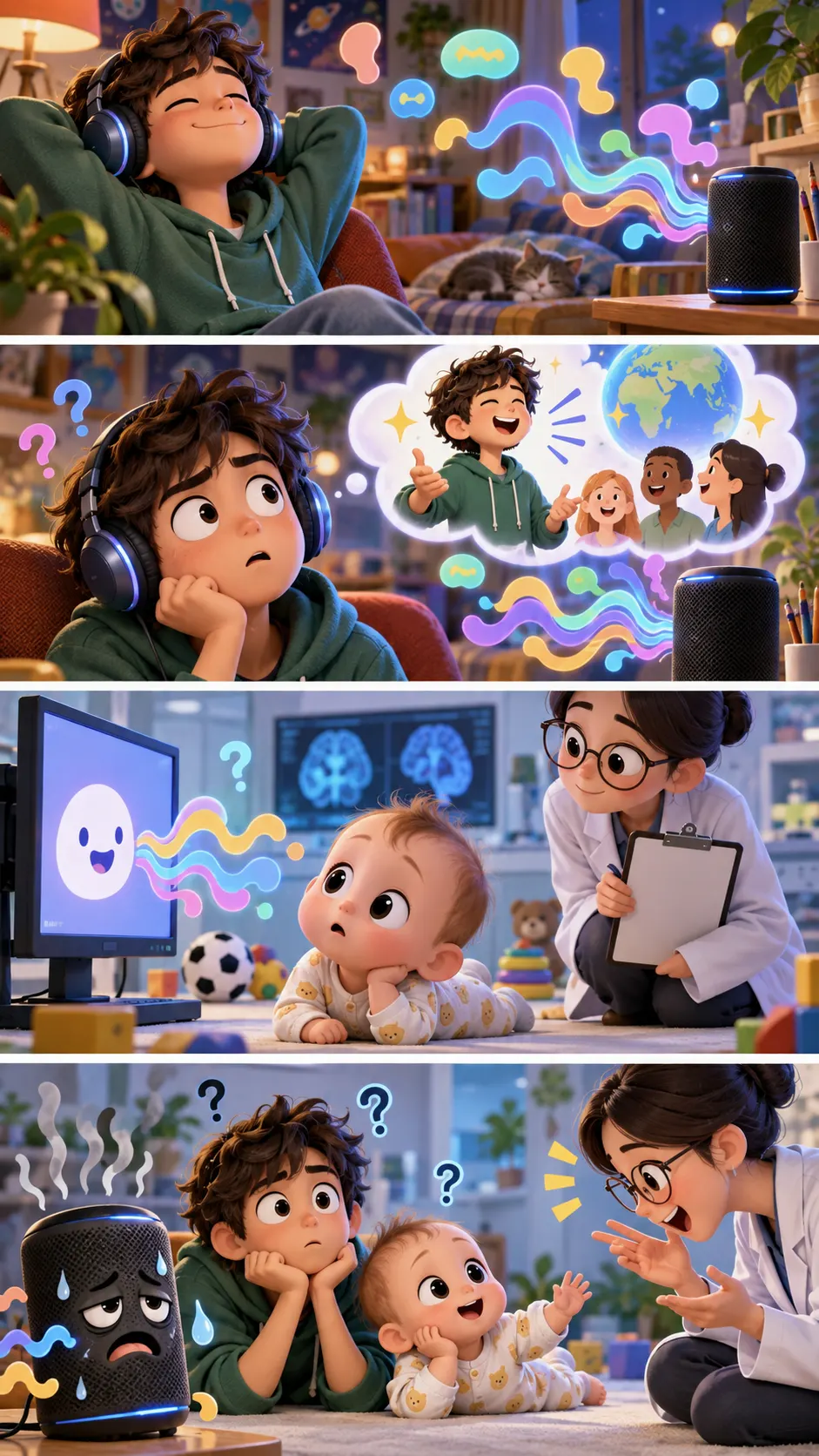
生後9か月の赤ちゃんに中国語を聞かせる実験で、目の前の人が話しかけた子は中国語の音を聞き分けられるようになったのに、同じ内容をビデオや音声で見聞きした子はまったく学べなかったらしい。聞き流し、赤ちゃんにも効かなかった。
押すと「マジかリスト」に保存されます
 出典・参考文献(4件)タップで表示
- Kuhl, Tsao & Liu (2003) Foreign-language experience in infancy: Effects of short-term exposure and social interaction on phonetic learning, PNASdoi.org
- Schmidt (1990) The role of consciousness in second language learning, Applied Linguisticsdoi.org
- van Zeeland & Schmitt (2013) Incidental vocabulary acquisition through L2 listening: A dimensions approach, Systemdoi.org
- Wright et al. (2015) Enhancing speech learning by combining task practice with periods of stimulus exposure without practice, The Journal of the Acoustical Society of Americadoi.org

※本記事は上記の研究・公開資料をもとに、原田英語が独自の言葉で解説したものです。引用は著作権法第32条の範囲で行い、出典を明記しています。画像はすべてオリジナルのイメージです。研究結果には限界や個人差があります。誤りのご指摘は原田英語のお問い合わせフォームから。