

 学習ハックビミョー
楽しみで本を読む子は、数学まで伸びていた。親の学歴より強かった「読書の力」
 2026.10.02
 English Corner(A2〜B2・4択クイズ)

 読む前に予想してみよう!
楽しみのための読書は、国語の力にしか関係しない
イギリスの追跡研究では、楽しみで本を読む子は語彙だけでなく数学でも伸びが大きい傾向があった。
 研究カード(どんな研究?)
- 対象
- 1970年生まれの英国人/フィンランドの子ども
- 規模
- 約3,600人/約2,500人
- 研究の種類
- 縦断研究(出生コホート・追跡調査)
- 確かさ
- ★★★☆☆
イギリスの約3,600人の追跡研究で、10歳のころ楽しみで本を読んでいた子は、16歳までに語彙も数学も大きく伸びていた。その関係は親の学歴よりも強かった。
ひとことで言うと楽しみで本を読むと、ことばの力だけでなく数学の力まで伸びるかも!
「本を読みなさい」は、大人が子どもに言いがちなセリフの代表格です。でも、「本を読むと何が良いの?」と聞かれると、「国語の成績が上がるから…?」くらいしか答えられないかもしれません。
ところが、イギリスで数千人を追いかけた研究によると、楽しみで本を読む子は、語彙だけでなく数学の力まで伸びていたのです。しかもその関係は、親の学歴よりも強かったといいます。
011970年生まれの約3,600人を追いかけた
同じ研究では、「楽器を演奏する」という別の文化的な活動も調べましたが、こちらは学力の伸びとはほとんど関係していませんでした。
02「読める子が読む」のか、「読むから読める」のか
もちろん、「もともと勉強ができる子が、読書も好きなだけでは?」という疑問は当然出てきます。
オランダのMolさんとBusさんは2011年、乳幼児から大学生までの99の研究(約7,700人)をまとめたメタ分析で、この問いに一つの答えを出しました。読む力が高い子ほどたくさん読み、たくさん読むほど読む力がさらに伸びるという「上向きのらせん(好循環)」があるというのです。
しかも、読書量と言葉の力の関係は、年齢が上がるほど強くなっていきました。読書が苦手な子も、自分から楽しんで読むことで恩恵を受けていたそうです。

03どんでん返し:「何を読むか」で結果がちがった
では、スマホでSNSやネット記事を読むのも「読書」になるのでしょうか。フィンランドのTorppaさんらは2020年、約2,500人の子どもを7歳から16歳まで追跡しました。
その結果、低学年のうちは「読む力が弱い子ほど読書をしなくなる」という向きの関係が目立ちました。一方、学年が上がると、余暇の読書が多い子ほど、その後の読解力が伸びるという関係が見られ、とくに本を読むことが読解力の伸びと結びついていました。
ところが、デジタルの文章を読むことは、読む力とマイナスの関係にありました。論文のタイトルにある通り、「読書なら何でもいい」わけではなかったのです。
04まとめ
楽しみで本を読む子は、語彙だけでなく数学の力まで伸びていた。しかも、その関係は親の学歴より強かった。読書は、家庭環境にかかわらず、誰でも始められる「学びのブースター」かもしれません。
ただし、カギは楽しんで読むことと、できれば本を読むこと。次の休みには、スマホを置いて、気になる1冊を手に取ってみませんか。
この研究を英語で読もう原田英語の English CornerAdults often tell children to read more, but what are the real benefits? 音声
音声 4択クイズ9問A2・B1・B2タップして開く
原田英語の English Corner
この研究を英語で読もう
Does reading for fun help you at school? A British study followed about 3,600 people born in 1970. Children who read books for pleasure learned more new words between the ages of 10 and 16.
They also made more progress in math. This link was even stronger than the link with their parents' education. A Finnish study found that reading books helped more than reading on screens.
67 words ・ CEFR A2
和訳を見る
楽しみのために本を読むことは、学校の勉強に役立つのでしょうか。イギリスのある研究は、1970年に生まれた約3,600人を追跡しました。楽しみで本を読んでいた子どもは、10歳から16歳の間により多くの新しい言葉を覚えました。
数学でもより大きく伸びていました。この結びつきは、親の学歴との結びつきよりも強いものでした。フィンランドの研究では、画面で読むよりも本を読む方が役に立つことがわかりました。
4択リーディングクイズ
Q1. What is the passage mainly about?
楽しみのための読書と学力の伸びの関係がテーマなので A。
Q2. Which subject, besides vocabulary, also improved?
they also made more progress in math とあるので B。
Q3. In this passage, "for pleasure" means ...
for pleasure は「楽しみのために」。自分が楽しいから読むという意味なので D。
Adults often tell children to read more, but what are the real benefits? Researchers at University College London analyzed data from about 3,600 people born in Britain in 1970. They took family background, parents' education and the number of books at home into account.
Even so, children who read for pleasure made greater progress in vocabulary between ages 10 and 16. Reading was also linked, more weakly, to progress in math.
In fact, the link between reading and progress was stronger than the link between parents' education and progress. A review of 99 studies describes an "upward spiral." Good readers read more, and reading more makes them even better readers. A Finnish study added one warning. Reading digital texts was linked to weaker reading skills.
125 words ・ CEFR B1
和訳を見る
大人はよく子どもにもっと本を読むように言いますが、本当の利点は何なのでしょうか。ユニバーシティ・カレッジ・ロンドンの研究者たちは、1970年にイギリスで生まれた約3,600人のデータを分析しました。彼らは家庭の背景、親の学歴、家にある本の数を考慮に入れました。
それでも、楽しみで本を読んでいた子どもは、10歳から16歳の間に語彙がより大きく伸びていました。読書は、より弱いものの、数学の伸びとも結びついていました。
実は、読書と学力の伸びの結びつきは、親の学歴と学力の伸びの結びつきよりも強かったのです。99の研究をまとめたレビューは「上向きのらせん」について述べています。読む力のある子ほどたくさん読み、たくさん読むほどさらに読む力が伸びるのです。フィンランドの研究は、1つ注意点を加えました。デジタルの文章を読むことは、読む力の弱さと結びついていたのです。
4択リーディングクイズ
Q1. What did the researchers in London find?
children who read for pleasure made greater progress in vocabulary とあるので C。
Q2. Which factor was the link with reading stronger than?
the link between reading and progress was stronger than the link between parents' education and progress とあるので D。
Q3. What does "upward spiral" mean in this passage?
直後に Good readers read more, and reading more makes them even better readers と説明があり、読書と読む力が互いを高め合う好循環のことなので A。
Children are told to read more all the time, but what reading actually does for them is rarely spelled out. Sullivan and Brown used the 1970 British Cohort Study to examine about 3,600 people who took vocabulary and mathematics tests at 16. They controlled for social class, parental education and the number of books at home.
Even then, reading for pleasure in childhood predicted greater vocabulary growth between ages 10 and 16 and, to a lesser extent, progress in mathematics. Its link with progress was stronger than that of parents' education. Playing a musical instrument, by contrast, showed little connection. An obvious objection is that able children may simply choose to read more.
A meta-analysis of 99 studies found that both directions operate, so skill and reading feed each other in an upward spiral. These are observational data, and unmeasured family factors could still play a part. A Finnish study that followed about 2,500 children from age 7 to 16 adds a point about format. In the later grades, leisure reading predicted later comprehension, especially when it involved books. Time spent reading digital texts went with weaker reading skill.
189 words ・ CEFR B2
和訳を見る
子どもはいつも「もっと本を読みなさい」と言われますが、読書が実際に子どもに何をもたらすのかが具体的に説明されることはめったにありません。SullivanさんとBrownさんは1970年英国出生コホート研究を使って、16歳で語彙と数学のテストを受けた約3,600人を調べました。彼らは社会階層、親の学歴、家にある本の数を統制しました。
それでもなお、子どものころの楽しみのための読書は、10歳から16歳の間の語彙の大きな伸びを予測し、程度は小さいものの数学の伸びも予測していました。読書と学力の伸びとの結びつきは、親の学歴の結びつきよりも強かったのです。対照的に、楽器の演奏はほとんど関係していませんでした。すぐに思いつく反論は、能力の高い子どもが単にたくさん読むことを選んでいるだけではないか、というものです。
99の研究のメタ分析では、両方向の関係が働いていて、能力と読書が「上向きのらせん」のように互いを強め合っていることが分かりました。これらは観察データなので、測定されていない家庭の要因が影響している可能性もあります。7歳から16歳まで約2,500人の子どもを追跡したフィンランドの研究は、読む媒体についての点を付け加えています。高い学年では、余暇の読書がその後の読解力を予測し、それは特に本を読む場合にあてはまりました。デジタルの文章を読む時間は、読む力の弱さと結びついていました。
4択リーディングクイズ
Q1. Why does the author mention playing a musical instrument?
by contrast とあり、楽器の演奏は伸びとほとんど関係しなかったと示して、読書との違いを際立たせているので B。
Q2. What did the Finnish study find about digital texts?
Time spent reading digital texts went with weaker reading skill. とあるので C。
Q3. What limitation does the author point out?
These are observational data, and unmeasured family factors could still play a part. とあるので D。
重要単語
- reading for pleasureB1名詞(句)楽しみのための読書Reading for pleasure helps build vocabulary.
 for pleasure「楽しみのために」⇔ for business「仕事で」。leisure reading とも言う。
 - vocabularyB1名詞語彙Her vocabulary grew a lot this year. 「単語1つ」ではなく「語彙全体」を指す。have a large vocabulary「語彙が豊富だ」。
- comprehensionB2名詞理解(力)Book reading predicted better reading comprehension. 動詞 comprehend(理解する)。comprehensive(包括的な)とは意味が違うので注意。
- cohortC1名詞同じ時期に生まれた集団The study followed a cohort born in 1970. cohort study「コホート研究」は同じ集団を長期間追跡する研究方法。
- leisureB2名詞余暇What do you do in your leisure time? 発音はアメリカ英語で /ˈliːʒər/(リージャー)、イギリス英語で /ˈleʒə/(レジャ)。
- upward spiralC1名詞(句)好循環Reading and skill create an upward spiral. 反対は downward spiral(悪循環)。vicious circle(悪循環)、virtuous circle(好循環)も同義。
 入試に出る順の単語帳を印刷する →
 全5561語の「科学英単語カード」で復習する →
 この話題を TED で聞く
同じテーマの TED・TED-Ed を、 TED HACK で。英語の見どころ・使える表現・学習ミッションつきの日本語ガイドです。(運営:原田英語)


 4コマでわかる
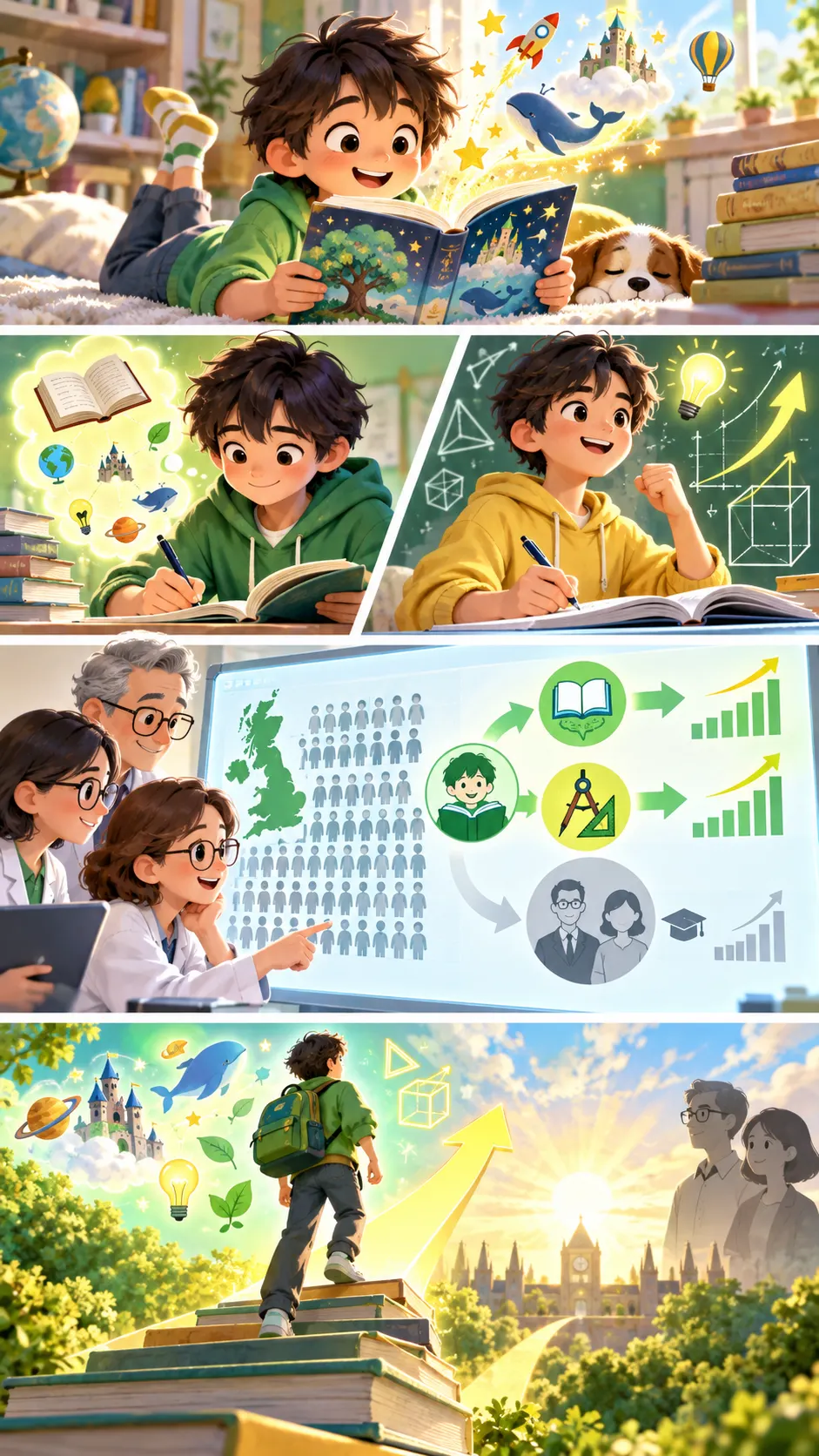
このネタ、誰かに教えたくなった?
イギリスで約3,600人を追跡した研究で、子どものころ楽しみで本を読んでいた人は、10〜16歳で語彙だけでなく数学の力まで大きく伸びていたらしい。しかもその関係は親の学歴より強かった。読むなら「本」がカギという研究も。
押すと「マジかリスト」に保存されます
出典・参考文献(3件)タップで表示
- Sullivan & Brown (2015) Reading for pleasure and progress in vocabulary and mathematics, British Educational Research Journaldoi.org
- Torppa et al. (2020) Leisure Reading (But Not Any Kind) and Reading Comprehension Support Each Other—A Longitudinal Study Across Grades 1 and 9, Child Developmentdoi.org
- Mol & Bus (2011) To read or not to read: A meta-analysis of print exposure from infancy to early adulthood, Psychological Bulletindoi.org

※本記事は上記の研究・公開資料をもとに、原田英語が独自の言葉で解説したものです。引用は著作権法第32条の範囲で行い、出典を明記しています。画像はすべてオリジナルのイメージです。研究結果には限界や個人差があります。誤りのご指摘は原田英語のお問い合わせフォームから。
 これも「マジか!?」
 学習ハック
学習ハック
「早生まれは不利」はどこまで本当? 4月生まれと3月生まれ、テストの点から人間関係まで
 学習ハック
学習ハック
男子校・女子校は成績が伸びる? 160万人のメタ分析では「差はほぼなし」、でも韓国の抽選校では…
 学習ハック
学習ハック
学校でスマホ禁止にすると成績は上がる? イギリスは「上がった」、スウェーデンは「変化なし」
 学習ハック
学習ハック
部活をやると成績は下がる? 115研究のメタ分析で「週1〜2時間」がちょうどよかった
 学習ハック
学習ハック
少人数クラスで成績は上がる? アメリカの大実験は「上がる」、イスラエルの再検証は「効果ゼロ」


 学習ハック
学習ハック