脳と心理ビミョー
年をとると記憶は「消える」より「混ざる」? 海馬の“再生パターン”が変わっていた
 2026.10.02
 English Corner(A2〜B2・4択クイズ)
 読む前に予想してみよう!
この研究では、高齢者は海馬の活動パターンの再現度が高いほど、記憶テストの成績が良かった
高齢者では、再現度が高いほど「同じジャンルの取り違え」がむしろ増えていた。
 研究カード(どんな研究?)
- 対象
- 18〜74歳の成人(若年・中年・高齢)
- 規模
- 61人
- 研究の種類
- fMRIを用いた実験研究(横断)
- 確かさ
- ★★☆☆☆
若者・中年・高齢者61人の脳を記憶課題中に撮影。高齢者は、海馬が記憶を「再生」するほど、同じジャンルの別のものと取り違える誤りが増えていた。
ひとことで言うと年をとると、思い出がなくなるより「ごちゃまぜ」になりやすいみたい。
「あの人の名前、なんだっけ」「この話、誰から聞いたんだっけ」。年をとると増える物忘れ。でも、それは本当に記憶が「消えて」いるのでしょうか?
2026年、科学誌『Cerebral Cortex』に、米国ビンガムトン大学の研究チームが興味深い結果を発表しました。高齢者の脳では、記憶が消えるというより、似たもの同士で「混ざって」しまうような変化が起きていたのです。
01顔と「物」「風景」のペアを覚える実験
間違いは2種類に分けて数えました。
- 同じジャンルの取り違え:正解が「物」なのに、別の「物」を選ぶ
- 違うジャンルの取り違え:正解が「物」なのに、「風景」を選ぶ
02年をとるほど正解が減る
結果、年齢が上がるほど、4択テストの正解率は下がっていました(若者36%、中年24%、高齢者20%)。論文の要旨は「同じジャンルの取り違えも年齢とともに増えた」としていますが、誤りがジャンル内に偏る度合いそのものは、本文の分析では年齢との関連が統計的に有意ではありませんでした。
脳の側を見ると、年齢が上がるほど、
- 覚えるとき → 休憩中 → 思い出すとき
の各段階の間で、海馬の活動パターンの似ている度合い(再現度)が下がっていました。記憶の「形」が、段階を移るたびに少しずつ崩れていたのです。
03高齢者では「再生するほど混ざる」
ここからがいちばんの驚きです。
- 若者:覚えたときと思い出すときのパターンが似ているほど、正解しやすかった
- 中年:その関係は弱まり
- 高齢者:関係はほぼなくなり、それどころか段階間の再現度が高いほど、同じジャンルの取り違えが増えた
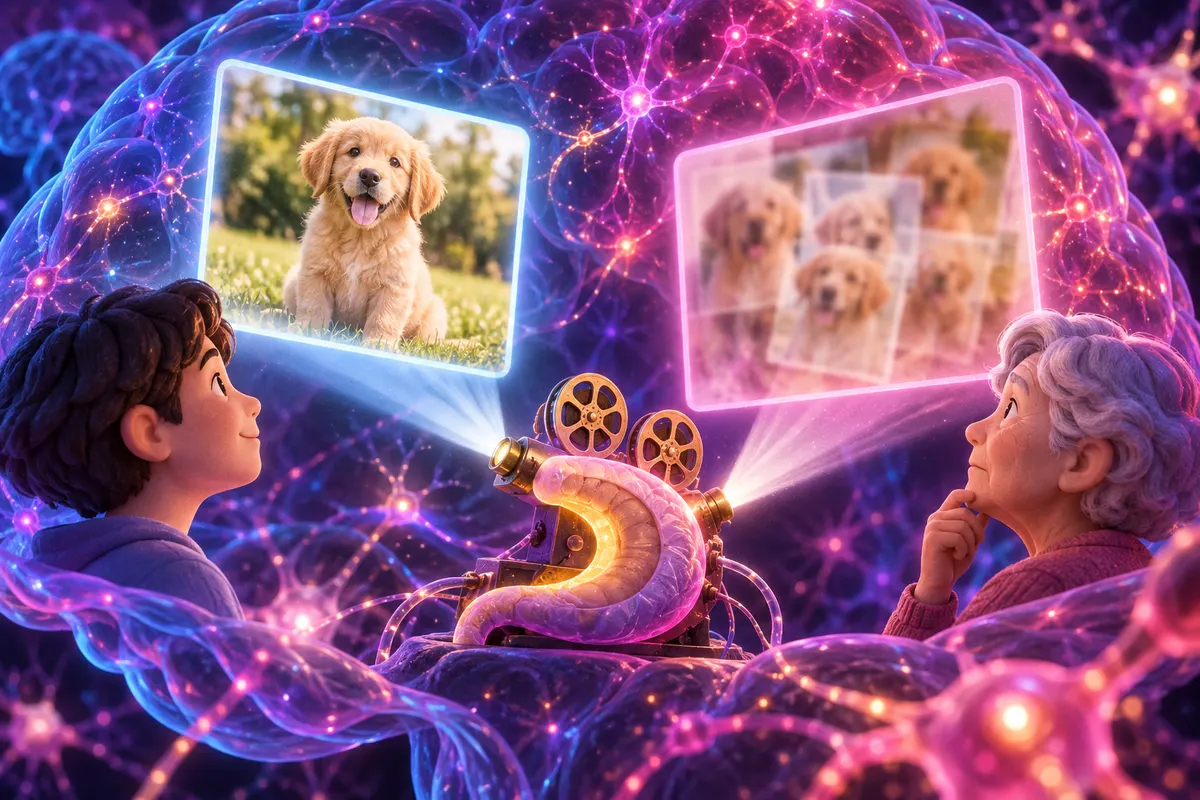
つまり高齢者の海馬は、記憶を「再生」してはいるものの、それが特定の1つではなく、ジャンル全体にぼやけた形で再生されている可能性があるのです。研究チームは、これを「選択的な再生」から「カテゴリーレベルの誤った結びつけ」への移行と表現しています。
04「結びつける力」が弱まるという仮説と一致
加齢で特に落ちやすいのは、単語や顔そのものの記憶より、「AとBがセットだった」という結びつきの記憶だということは、以前から指摘されてきました(Naveh-Benjamin, 2000;メタ分析 Old & Naveh-Benjamin, 2008)。今回の研究は、その背景にある海馬の表現の不安定さを描き出したといえます。
05まとめ
年をとると記憶は「消える」というより、似たもの同士で「混ざる」——。だとすれば、大事な予定や約束は、ほかと区別できる手がかり(場所・色・理由など)と一緒に覚えておくのが良い作戦かもしれません。記憶は消しゴムで消えるのではなく、にじんでいくものなのかもしれません。
この研究を英語で読もう原田英語の English CornerForgetting is often thought to be a normal part of aging, but researchers at Binghamton University in the… 音声
音声 4択クイズ9問A2・B1・B2タップして開く
原田英語の English Corner
この研究を英語で読もう
Many older people say, "I forget things." But are their memories really lost? Scientists in the US tested 61 adults of different ages. People looked at pairs, such as a face and an object, and tried to remember them.
Older people often chose the wrong object, not a place. They may have remembered the type of thing, but mixed up which one. So, with age, memories may get mixed rather than disappear.
72 words ・ CEFR A2
和訳を見る
多くの年配の人は「物忘れをする」と言います。でも、その記憶は本当に失われているのでしょうか。アメリカの科学者たちは、さまざまな年齢の大人61人をテストしました。参加者は、顔と物のようなペアを見て、それを覚えようとしました。
年配の人は、風景ではなく、違う物を選ぶことがよくありました。彼らは物の種類は覚えていたのかもしれませんが、どれだったかを取り違えたのです。つまり、年をとると、記憶は消えるというより混ざるのかもしれません。
4択リーディングクイズ
Q1. What is the passage mainly about?
年をとると記憶が消えるより混ざるのかもしれない、という研究の内容なので A が正解。
Q2. What did older people often do in the test?
Older people often chose the wrong object, not a place. とあるので B。
Q3. In this passage, "mixed up" means ...
mix up は「混同する、取り違える」。どの物だったかを取り違えた、という意味なので D。
Forgetting is often thought to be a normal part of aging, but researchers at Binghamton University in the US suggest that older people's memories may be blended rather than erased. In their study, 61 adults aged 18 to 74 learned pairs of faces and objects or faces and scenes while their brains were scanned.
Later, they were asked which item had been paired with each face. Older participants made more mistakes, including more within the same category, such as choosing a different object instead of the correct one. Brain scans showed that, with age, activity patterns in the hippocampus, a key memory area, became less stable. In older adults, stronger replay of these patterns was even linked to more mix-ups.
120 words ・ CEFR B1
和訳を見る
物忘れは加齢の普通の一部だと考えられがちですが、アメリカのビンガムトン大学の研究者たちは、年配の人の記憶は消されるのではなく混ざり合っているのかもしれないと示唆しています。研究では、18〜74歳の大人61人が、脳をスキャンされながら顔と物、または顔と風景のペアを覚えました。
その後、それぞれの顔とペアだったのはどれかを尋ねられました。年配の参加者は間違いが多くなり、正しい物の代わりに別の物を選ぶなど、同じカテゴリー内での間違いも多くなりました。脳スキャンからは、年齢とともに、記憶の重要な領域である海馬の活動パターンが不安定になることが分かりました。高齢者では、こうしたパターンの再生が強いほど、取り違えがむしろ多くなっていました。
4択リーディングクイズ
Q1. What is the main idea of the passage?
第1文の older people's memories may be blended rather than erased が主旨なので D。
Q2. What kind of mistake did older participants make more often?
more within the same category, such as choosing a different object とあるので C。
Q3. What can we infer from the last sentence?
高齢者では stronger replay ... was even linked to more mix-ups とあるので、強く再生しても正解につながるとは限らない。B が正解。
Researchers at Binghamton University asked 61 adults, split into young, middle-aged and older groups, to learn face-object and face-scene pairs inside an fMRI scanner. After a rest, the volunteers tried to recall the item that went with each face.
The team, publishing in Cerebral Cortex, sorted the mistakes into two kinds. Some were wrong items from the same category. Others came from a different category. With age, accuracy fell and same-category errors seemed to rise. The hippocampus changed too.
Its activity patterns during learning, rest and recall grew less similar. Among young adults, those who reproduced their learning patterns more faithfully gave more correct answers. That link was weaker in middle age and gone in older adults, for whom stronger reinstatement actually went with more same-category errors.
So memory loss in later life may not be a simple fading of information. The aging hippocampus may replay a blurry, category-level version of a memory instead of the specific one, which fits a long-standing idea that binding information together is especially vulnerable to aging. Each group had only 17 to 23 people, though, and the study compared different people at one point in time instead of following the same people as they aged.
201 words ・ CEFR B2
和訳を見る
ビンガムトン大学の研究者たちは、若年・中年・高齢の3グループに分けた61人の成人に、fMRIスキャナーの中で顔と物、顔と風景のペアを覚えてもらいました。休憩の後、参加者はそれぞれの顔に結びついていたものを思い出そうとしました。
『Cerebral Cortex』に結果を発表したチームは、誤りを2種類に分けました。一つは同じカテゴリーから間違ったものを選ぶ誤りです。もう一つは、別のカテゴリーから選ぶ誤りでした。年齢とともに、正解が減り、同じカテゴリー内の誤りも増えたようでした。海馬にも変化がありました。覚える段階・休憩・思い出す段階の活動パターンが似なくなっていったのです。
若者では、覚えたときのパターンを忠実に再現した人ほど正答が多くなりました。この関係は中年で弱まり、高齢者では消えていました。高齢者では、再現が強いほど、むしろ同じカテゴリー内の誤りが多かったのです。
つまり、晩年の記憶の衰えは、単に情報が薄れていくことではないのかもしれません。加齢した海馬は、特定の記憶の代わりに、カテゴリー単位のぼやけた記憶を再生しているのかもしれず、これは情報を結びつける力が特に加齢の影響を受けやすいという以前からの考えとも合っています。ただし、各グループは17〜23人しかおらず、この研究は同じ人を年齢を重ねるにつれて追跡したのではなく、ある一時点で別々の人を比べたものです。
4択リーディングクイズ
Q1. What is the passage mainly about?
加齢によって海馬の記憶の再生のされ方が変わることを示した研究の紹介なので C。
Q2. What happened to the link between reinstatement and accuracy in older adults?
gone in older adults, for whom stronger reinstatement actually went with more same-category errors とあるので A。
Q3. Which is a limitation of the study mentioned by the author?
最終文に the study compared different people at one point in time instead of following the same people as they aged とあるので B。
重要単語
- episodic memoryC1名詞(句)エピソード記憶(出来事の記憶)Episodic memory lets us recall what happened yesterday.
 episode(出来事)の形容詞形 episodic。「いつ・どこで・何が」の記憶。semantic memory(意味記憶)と対で覚える。
 - hippocampusC1名詞海馬The hippocampus is important for forming new memories. ギリシャ語で「タツノオトシゴ」。形がタツノオトシゴに似ていることから。複数形は hippocampi。
- bindB2動詞結びつけるThe brain binds a face to a place. 活用は bind-bound-bound。be bound to do「きっと~する」も入試頻出。名詞 binding は「結びつけ」。
- reinstatementC1名詞再現、復元Memory reinstatement means the brain replays a past pattern. re-(再び)+instate(ある状態に置く)。動詞 reinstate は「復職させる」の意味でもニュースに出る。
- distortionC1名詞ゆがみMemory distortion is common in everyday life. 動詞 distort(ゆがめる)。dis-(離れて)+tort(ねじる)。torture(拷問)と同じ語根。
- declineB2名詞・動詞低下(する)、減少(する)Memory decline is common in later life. decline in ~「~の低下」の前置詞 in に注意。「断る」の意味もある多義語。
- vulnerableC1形容詞弱い、影響を受けやすいBinding information is especially vulnerable to aging. be vulnerable to ~「~に弱い」。ラテン語 vulnus(傷)から。難関大長文の定番語。
 入試に出る順の単語帳を印刷する →
 全5561語の「科学英単語カード」で復習する →
 この話題を TED で聞く
同じテーマの TED・TED-Ed を、 TED HACK で。英語の見どころ・使える表現・学習ミッションつきの日本語ガイドです。(運営:原田英語)

このネタ、誰かに教えたくなった?
年をとると物忘れが増えるのは「記憶が消えるから」だと思ってた。でも61人の脳を調べた研究で、高齢者は海馬が記憶を再生しても「同じジャンルの別のもの」と取り違えやすかったらしい。記憶は消えるより、混ざっていくのかも。
押すと「マジかリスト」に保存されます
 出典・参考文献(3件)タップで表示
- Mekbib & McDonough (2026) Aging shifts hippocampal reactivation from selective reinstatement to category-level misbinding during episodic memory, Cerebral Cortexdoi.org
- Naveh-Benjamin (2000) Adult age differences in memory performance: Tests of an associative deficit hypothesis, Journal of Experimental Psychology: Learning, Memory, and Cognitiondoi.org
- Old & Naveh-Benjamin (2008) Differential effects of age on item and associative measures of memory: A meta-analysis, Psychology and Agingdoi.org

※本記事は上記の研究・公開資料をもとに、原田英語が独自の言葉で解説したものです。引用は著作権法第32条の範囲で行い、出典を明記しています。画像はすべてオリジナルのイメージです。研究結果には限界や個人差があります。誤りのご指摘は原田英語のお問い合わせフォームから。