

 体と健康・食ホント
アスパラガスを食べた後のおしっこの“におい”、6割の人は、はっきりとは気づかない。7000人の遺伝子研究
 2026.10.02
 English Corner(A2〜B2・4択クイズ)
 読む前に予想してみよう!
アスパラガスを食べた後のおしっこのにおいは、全員がはっきり気づく
米国の研究では、男性の約58%、女性の約62%が「強いにおいに気づく」に強く同意しなかった。
 研究カード(どんな研究?)
- 対象
- 米国の成人(ヨーロッパ系)
- 規模
- 6,909人
- 研究の種類
- ゲノムワイド関連解析
- 確かさ
- ★★★☆☆
アスパラガスを食べた後の尿の独特なにおいに、約7000人の研究では6割前後が「強いにおいに気づく」とは答えなかった。においセンサーの遺伝子が関係。
ひとことで言うとアスパラのおしっこのにおい、わかる人とわからない人がいる!
ちょっと食事中には読みにくい話かもしれませんが……。
アスパラガスを食べたあと、トイレでおしっこのにおいが変わったことに気づいたことはありますか? ゆでたキャベツや硫黄のような、独特のにおいです。
「え、そんなの知らない」という人。実はあなたは、少数派ではなく多数派かもしれません。アメリカの約7000人を調べた研究では、6割前後の人が、このにおいに「強く気づく」とは答えなかったのです。
01においの正体は「硫黄」の仲間
アスパラガスには、アスパラガス酸という、硫黄を含む成分が入っています。食べると体の中で分解され、硫黄を含むにおいの強い物質ができて、おしっこに出てきます。
このにおいは、早ければ食後15〜30分ほどで現れることもあるといわれ、昔から科学者たちの好奇心を刺激してきました。18世紀にはすでに記録があるほどです。
02「におわない人」は2種類いる
2011年、アメリカのモネル化学感覚研究所のペルチャットさんらは、この現象をていねいに調べました。
すると、においに気づかない理由には、2種類あることがわかりました。
- そもそもにおいの物質をあまり作らない人(体の分解のしかたのちがい)
- 物質は出ているのに、においを感じとれない人(嗅覚のちがい)
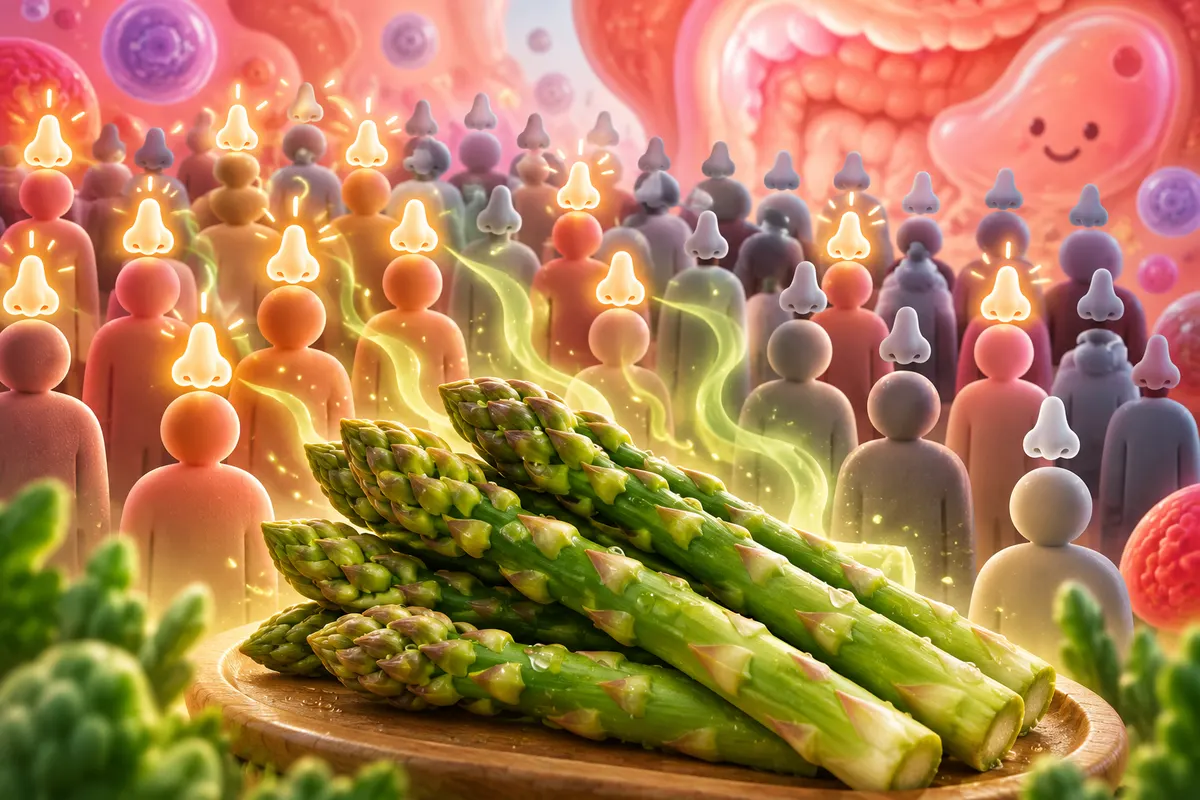
そして、感じとれないかどうかには、においセンサーの遺伝子の近くにある1文字のちがいが関係していそうだ、ということも報告されました。
037000人の遺伝子を調べたら
この論文は、イギリスの医学誌『BMJ』のクリスマス号に掲載されました。クリスマス号は、まじめな方法でユーモアのあるテーマを扱う論文が載ることで知られています。タイトルも「"Pee(おしっこ)値"をかぎ分ける」という、統計の「P値」にかけたダジャレでした。
04「特定のにおいだけわからない」は珍しくない
このように、嗅覚全体はふつうなのに、特定のにおいだけ感じとれないことを特異的嗅覚脱失といいます。パクチーの「石けん臭」や、ある種の汗のにおいなどでも、感じ方に大きな個人差があることが知られています。
私たちは同じ世界にいるようで、においについては、一人ひとりちがう世界を生きているのかもしれません。
05まとめ
アスパラガスを食べたあとのおしっこのにおい。「強いにおいに気づく」と言い切れない人のほうが多いことが、約7000人の遺伝子研究からわかりました。その裏には、においセンサーの遺伝子のちがいがありました。
同じものを食べても、感じている世界は人それぞれ。ちょっとトイレの話ですが、においの個人差という奥深い科学の入り口なのです。
この研究を英語で読もう原田英語の English CornerAfter eating asparagus, many people's urine has a strong smell, a bit like cooked cabbage. 音声
音声 4択クイズ9問A2・B1・B2タップして開く
原田英語の English Corner
この研究を英語で読もう
Some people notice a strange smell in their urine after they eat asparagus. It smells a little like cooked cabbage. The smell comes from sulfur in the vegetable.
But many people never notice it. In a study of about 7,000 Americans, around 60% did not say they noticed a strong smell. Scientists found that this was linked to genes for smell sensors in the nose. So each of us may live in a different world of smells.
77 words ・ CEFR A2
和訳を見る
アスパラガスを食べた後、おしっこに変わったにおいがすることに気づく人がいます。それは少し、ゆでたキャベツのようなにおいです。このにおいは、この野菜に含まれる硫黄から来ます。
しかし、多くの人はまったく気づきません。約7000人のアメリカ人を対象にした研究では、約60%の人が強いにおいに気づいたとは答えませんでした。科学者たちは、これが鼻にあるにおいセンサーの遺伝子と関係していることを発見しました。つまり、私たち一人ひとりは、においについてちがう世界に住んでいるのかもしれません。
4択リーディングクイズ
Q1. What is the passage mainly about?
アスパラガスの後の尿のにおいに気づかない人が多く、それが遺伝子と関係する、という内容なので C。
Q2. About what percentage of people in the study did not say they noticed a strong smell?
around 60% did not say they noticed a strong smell とあるので D。
Q3. In this passage, "sensors" are things that ...
smell sensors は「においを感じとる(検知する)もの」。sense(感じる)+-or と考えると分かりやすいので A。
After eating asparagus, many people's urine has a strong smell, a bit like cooked cabbage. This happens because the vegetable contains asparagusic acid, which the body breaks down into smelly sulfur compounds.
However, not everyone notices it. A 2011 study found two different reasons. Some people produce only a little of the smelly substance, while others produce it but cannot detect it. In 2016, researchers at Harvard analyzed genetic data from 6,909 adults of European ancestry.
About 58% of the men and 61.5% of the women did not strongly agree that they noticed the smell. The ability to smell it was linked to differences near a group of smell receptor genes. Missing just one particular smell like this is called specific anosmia.
122 words ・ CEFR B1
和訳を見る
アスパラガスを食べた後、多くの人の尿は、少しゆでたキャベツのような強いにおいがします。これは、この野菜にアスパラガス酸が含まれていて、体がそれをにおいの強い硫黄化合物に分解するために起こります。
しかし、だれもがそれに気づくわけではありません。2011年の研究で、2つの異なる理由が見つかりました。においの物質を少ししか作らない人がいる一方で、作ってはいるのに感じとれない人もいるのです。2016年、ハーバード大学の研究者たちは、ヨーロッパ系の成人6,909人の遺伝子データを分析しました。
男性の約58%、女性の61.5%が、においに気づくことに「強く同意」しませんでした。においを感じとる能力は、においの受容体遺伝子群の近くにあるちがいと関連していました。このように特定のにおいだけがわからないことは、特異的嗅覚脱失と呼ばれます。
4択リーディングクイズ
Q1. According to the 2011 study, why do some people not notice the smell?
some people produce only a little ..., while others produce it but cannot detect it と2つの理由が書かれているので B。
Q2. What percentage of women did not strongly agree that they noticed the smell?
58% of the men and 61.5% of the women とあり、女性は 61.5% なので C。58% は男性の数値。
Q3. What can we infer about a person with specific anosmia?
Missing just one particular smell ... is called specific anosmia とあり、特定のにおいだけがわからない状態なので A。
Eat asparagus, and shortly afterward your urine may carry a distinctive smell. Scientists have been curious about it since at least the eighteenth century. The odor is thought to come from asparagusic acid, a sulfur-containing compound that the body breaks down into strong-smelling metabolites. Many people, though, say they have never noticed anything.
Earlier work at the Monell Chemical Senses Center had shown that people differ both in how much of the odor they produce and in whether they can perceive it. In 2016, a Harvard team ran a genome-wide association study of 6,909 participants of European ancestry, drawn from large surveys of health professionals. Anyone who did not strongly agree that they noticed the smell was classed as unable to detect it. That covered 58% of men and 61.5% of women.
The method had a blind spot. A single self-reported question cannot separate people who do not produce the odor from people who cannot smell it. The sample also came from one ancestry, and the authors themselves called for the work to be repeated. Even so, variants in a cluster of olfactory receptor genes on chromosome 1 were associated with being unable to detect the smell.
197 words ・ CEFR B2
和訳を見る
アスパラガスを食べると、その少しあとで尿に独特のにおいが出ることがあります。科学者たちは少なくとも18世紀から、このにおいに関心を持ってきました。においのもとは、硫黄を含む化合物であるアスパラガス酸だと考えられており、体がそれを強いにおいの代謝物に分解するのです。ところが、一度も気づいたことがないと言う人も多くいます。
モネル化学感覚研究所での以前の研究は、においをどれだけ作るか、そしてそれを知覚できるかの両方に個人差があることを示していました。2016年、ハーバード大学のチームは、医療職を対象とした大規模調査から集めたヨーロッパ系の参加者6,909人について、ゲノムワイド関連解析を行いました。においに気づくことに「強く同意」しなかった人は、においを感知できない人に分類されました。これに当たったのは男性の58%、女性の61.5%です。
この方法には死角がありました。自己申告による1つの質問だけでは、においを作らない人と、においを感じとれない人を区別できないのです。また、対象は1つの祖先集団に限られており、著者ら自身が再現研究を呼びかけていました。それでも、1番染色体にある嗅覚受容体遺伝子群の変異が、においを感知できないことと関連していました。
4択リーディングクイズ
Q1. What is the passage mainly about?
アスパラガス後の尿のにおいを感じとれるかどうかの遺伝子研究と、その限界を述べた文章なので A。
Q2. Where were the genetic variants linked to the trait found?
Variants in a cluster of olfactory receptor genes on chromosome 1 were associated with being unable to detect the smell とあるので C。
Q3. Why could the 2016 study NOT separate "non-producers" from "non-smellers"?
A single self-reported question cannot separate people who do not produce the odor from people who cannot smell it とあるので D。自己申告1問という方法上の限界。
重要単語
- urineB2名詞尿、おしっこAsparagus can change the smell of urine.
 発音は /ˈjʊərɪn/(ユアリン)。動詞は urinate。医療系の長文で出る。
 - odorB2名詞におい(特に不快なもの)The odor reminded me of cooked cabbage. イギリス式は odour。smell より硬く、body odor(体臭)のように使う。
- anosmiaC1名詞嗅覚脱失(においを感じないこと)Specific anosmia means missing just one smell. an-(否定)+osm(におい)。specific anosmia は「特定のにおいだけわからない」こと。
- metaboliteC1名詞代謝物The smell comes from metabolites of asparagus. metabolism(代謝)と同語源。体が物質を分解・変換してできたもの。
- sulfurB2名詞硫黄Sulfur compounds often smell strong. イギリス式は sulphur。温泉や卵の腐ったにおいのもと。
- detectB2動詞感知する・検出するSome people cannot detect the smell at all. 名詞は detection、detective(探偵)も同じ仲間。「見つけ出す」イメージ。
- ancestryC1名詞祖先・家系All participants were of European ancestry. ancestor(祖先)の集合名詞。遺伝子研究で対象集団を示すときの定番語。
 入試に出る順の単語帳を印刷する →
 全5561語の「科学英単語カード」で復習する →
 動画でもっと知る
動画は各チャンネルの公式埋め込みで表示しています(YouTube)。
この話題を TED で聞く
同じテーマの TED・TED-Ed を、 TED HACK で。英語の見どころ・使える表現・学習ミッションつきの日本語ガイドです。(運営:原田英語)


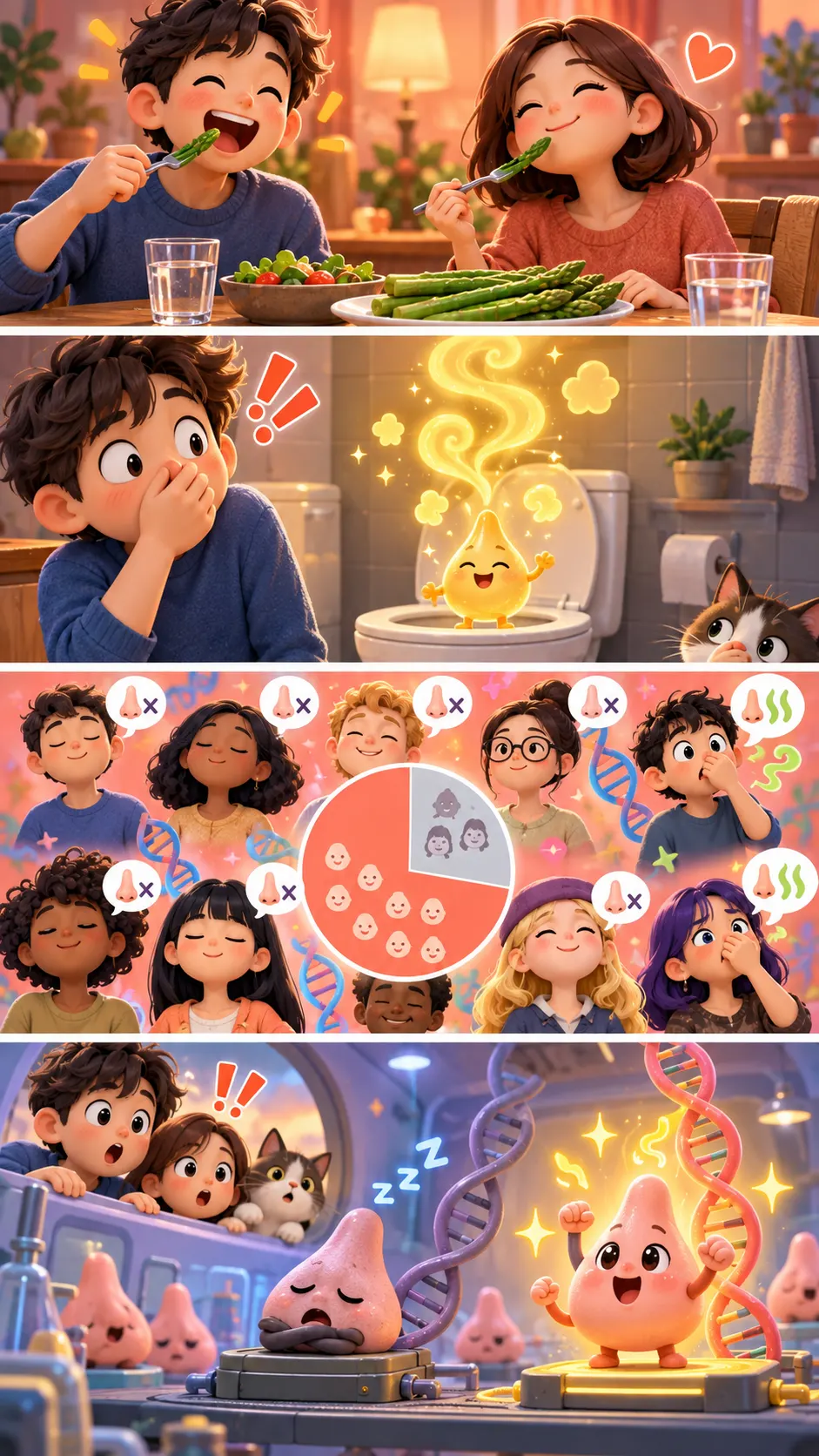
 4コマでわかる
このネタ、誰かに教えたくなった?
アスパラを食べた後、おしっこが独特のにおいになる人がいる。でも米国の約7000人の研究では、6割前後が「強いにおいに気づく」とは答えなかった。においセンサーの遺伝子の違いが関係しているらしい。
押すと「マジかリスト」に保存されます
 出典・参考文献(3件)タップで表示
- Markt et al. (2016) Sniffing out significant "Pee values": genome wide association study of asparagus anosmia, BMJdoi.org
- Pelchat et al. (2011) Excretion and perception of a characteristic odor in urine after asparagus ingestion: a psychophysical and genetic study, Chemical Sensesdoi.org
- Mitchell (2013) Asparagus, urinary odor, and 1,2-dithiolane-4-carboxylic acid, Perspectives in Biology and Medicinedoi.org

※本記事は上記の研究・公開資料をもとに、原田英語が独自の言葉で解説したものです。引用は著作権法第32条の範囲で行い、出典を明記しています。画像はすべてオリジナルのイメージです。研究結果には限界や個人差があります。誤りのご指摘は原田英語のお問い合わせフォームから。
 これも「マジか!?」
 体・健康
体・健康
パクチーが「石けんの味」に感じる人は遺伝子のせい? 2.6万人の調査が見つけた“においセンサー”

 体・健康
体・健康
大人になって牛乳が苦手になるのは「人類の標準」だった。むしろ平気な人が“突然変異”

 体・健康
体・健康
耳あかが「カサカサ」か「ベタベタ」かは、遺伝子のたった1文字の違いで決まっていた
 体・健康
体・健康
鼻をつまむとジュースの味がわからない。「味」の多くは“口から鼻へ抜ける香り”だった
 体・健康
体・健康
ブロッコリーが苦く感じるのは、わがままじゃなかった。苦味センサー「TAS2R38」の個人差
 体・健康
体・健康