

 動物・植物ホント
ハエトリグサは触られた回数を「数えて」いた。2回で閉じ、もっと暴れると消化開始
 2026.10.02
 English Corner(A2〜B2・4択クイズ)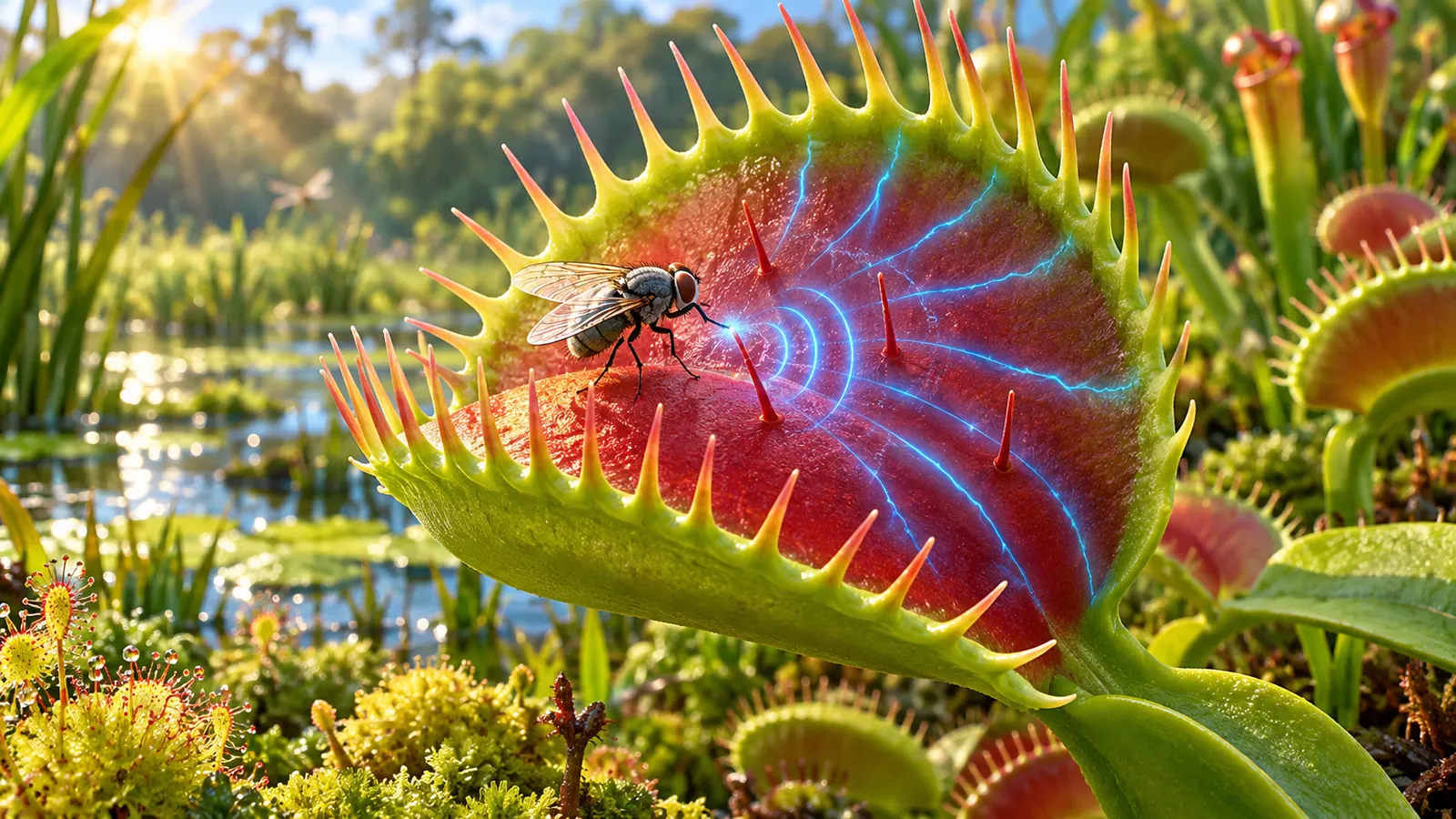
 読む前に予想してみよう!
ハエトリグサは、感覚毛に1回さわっただけですぐに葉を閉じる
ふつうは約30秒以内に2回の刺激が必要。ゴミや雨粒で無駄に閉じないための仕組みと考えられている。
 研究カード(どんな研究?)
- 対象
- ハエトリグサ(Dionaea muscipula)
- 規模
- 実験室での刺激実験
- 研究の種類
- 電気生理・遺伝子発現・カルシウムイメージング
- 確かさ
- ★★★★☆
ハエトリグサは感覚毛への刺激を数え、約30秒以内に2回で葉を閉じる。さらに刺激が続くと消化酵素の遺伝子が働き出す。脳はないのに“数える”植物。
ひとことで言うとハエトリグサは「2回さわられたら閉じる」。ちゃんと数えてる!
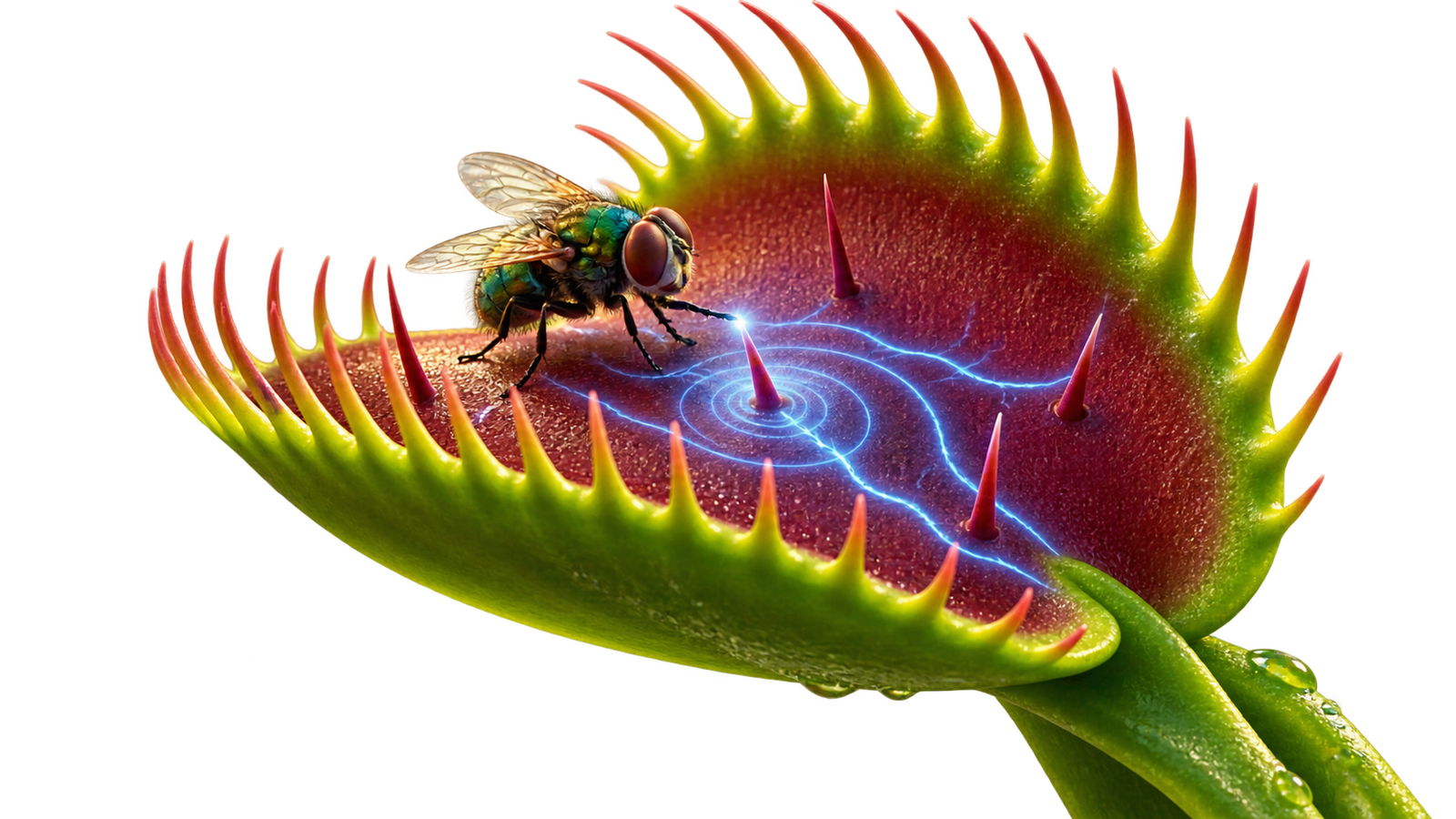
ハエトリグサの葉の内側には、まつげのような感覚毛が数本生えています。ここに虫がふれると、葉がパクッと閉じる――。
でも実は、1回さわっただけでは閉じません。ハエトリグサは、さわられた回数を「数えて」いるのです。しかも数えるのは2回まで、ではありません。
011回目は「様子見」、2回目で「パクッ」
感覚毛が曲げられると、葉に電気信号(活動電位)が流れます。でも1回だけなら、葉は動きません。約30秒以内にもう1回信号が来たときに、初めて閉じるのです。
これは、とても理にかなっています。雨粒やゴミが一度当たっただけで閉じていたら、エネルギーの無駄づかい。動き回る虫なら、短い時間に何度も毛にふれるはずです。
閉じる動き自体は0.1〜0.3秒ほど。植物の中でもトップクラスの速さです。フランスとアメリカの研究チーム(Forterreら、2005年)は、ふくらんだ葉が“パチン”と反り返るスナップ(座屈)の仕組みで、筋肉なしにこの速さを生んでいることを示しました。
02「2回目」をどうやって覚えているのか
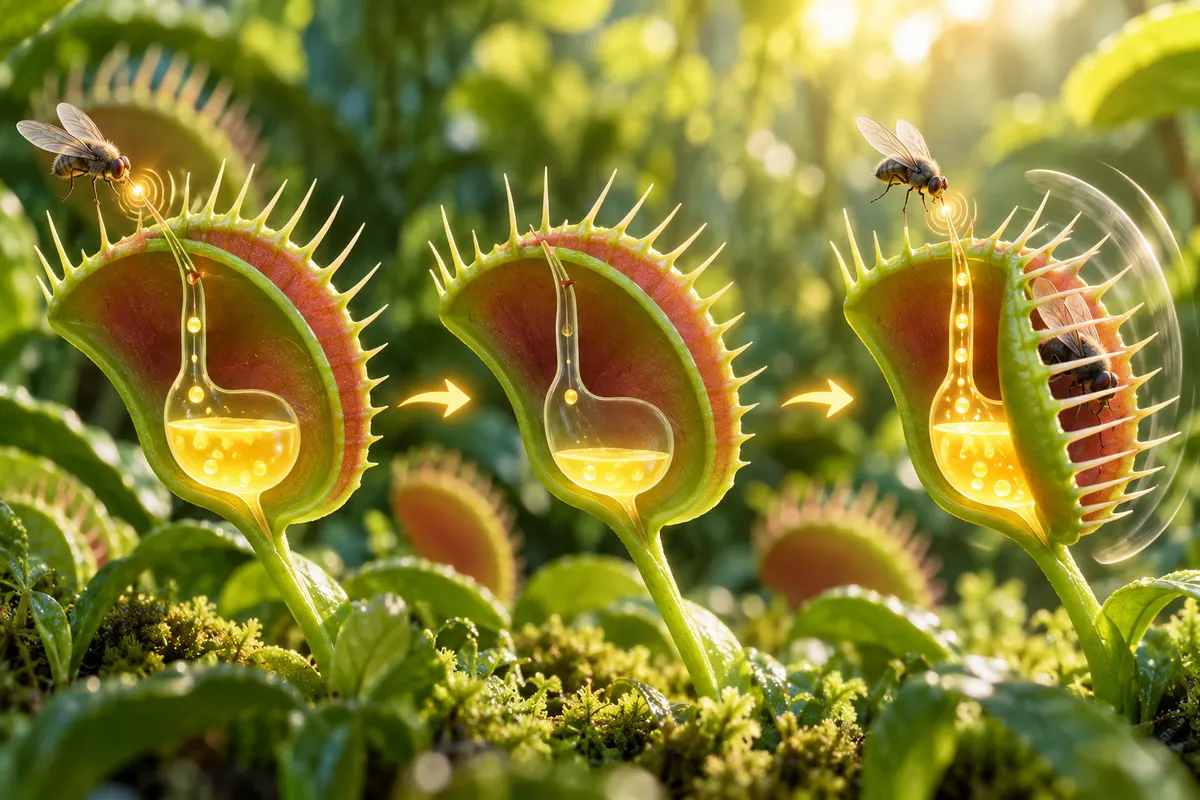
1回目の刺激を、植物はどこに「メモ」しているのでしょう?
脳も神経もないのに、カルシウムの“たまり具合”で回数を記憶している。まさに化学の電卓です。
03閉じたあとも、数え続けていた
ドイツ・ヴュルツブルク大学のヘドリッヒ(Hedrich)さんらのチーム(Böhmら、2016年、『Current Biology』)は、閉じたあとの葉を何度も刺激しました。
すると、2回目の刺激で「接触ホルモン」と呼ばれるジャスモン酸の経路がオン。3回を超えると、獲物を分解する消化酵素の遺伝子が働き出し、その量は刺激の回数に比例して増えました。さらに、獲物の体から出るナトリウムを取りこむための通り道(DmHKT1)の遺伝子も、刺激の回数に応じて増えていたのです。
つまりハエトリグサは、閉じこめた相手が「暴れ続けている=生きたごちそう」かどうかを、刺激の回数で見きわめているわけです。
04まとめ
ハエトリグサは、1回目は様子見、2回目でパクッ、そのあとは暴れた回数を数えて「食べるかどうか」を決めていました。
脳がなくても、カルシウムと電気信号で“数を数える”ことはできる。植物の頭のよさは、私たちが思うよりずっと奥深いのです。
この研究を英語で読もう原田英語の English CornerThe Venus flytrap seems to be able to count. 音声
音声 4択クイズ9問A2・B1・B2タップして開く
原田英語の English Corner
この研究を英語で読もう
The Venus flytrap is a plant that eats insects. Inside its leaves, there are a few small hairs. When an insect touches a hair once, nothing happens.
But if it touches a hair again within about 30 seconds, the leaf closes very quickly. This way, the plant does not close for rain or dust. After the leaf closes, the insect keeps moving. Then the plant starts to make juices to digest it.
72 words ・ CEFR A2
和訳を見る
ハエトリグサは虫を食べる植物です。葉の内側には、小さな毛が数本あります。虫が毛に1回ふれても、何も起こりません。
しかし約30秒以内にもう一度ふれると、葉はとても素早く閉じます。こうすることで、植物は雨やゴミのために閉じることがありません。葉が閉じたあとも、虫は動き続けます。すると植物は、虫を消化するための液を作り始めます。
4択リーディングクイズ
Q1. What is the passage mainly about?
ハエトリグサが何回ふれられたら閉じ、消化を始めるかが主題なので A。
Q2. When does the leaf close?
if it touches a hair again within about 30 seconds, the leaf closes とあるので C。
Q3. In the passage, "digest" means ...
digest は「消化する」=食べ物を分解すること。make juices to digest it の流れからも B。
The Venus flytrap seems to be able to count. When an insect bends one of the trigger hairs inside its leaf, an electrical signal travels through the leaf, but the trap does not close. It snaps shut only if a second signal arrives within about 30 seconds. This saves energy, because a raindrop usually touches the hair just once, while a living insect moves around.
In 2020, Japanese researchers made flytraps that glow when calcium increases. They found that each touch raised the calcium level, and the trap closed when the level passed a certain line. A German study showed that after the trap closes, more than three touches switch on the genes for digestive enzymes.
116 words ・ CEFR B1
和訳を見る
ハエトリグサは数を数えられるようです。虫が葉の内側の感覚毛の1本を曲げると、電気信号が葉を伝わりますが、わなは閉じません。約30秒以内に2回目の信号が届いたときだけ、パチンと閉じるのです。雨粒はたいてい毛に1回しかふれませんが、生きた虫は動き回るので、これによってエネルギーが節約されます。
2020年、日本の研究者たちは、カルシウムが増えると光るハエトリグサを作りました。その結果、ふれるたびにカルシウムの濃度が上がり、濃度がある線を超えるとわなが閉じることがわかりました。ドイツの研究では、わなが閉じたあと、3回を超える刺激で消化酵素の遺伝子が働き出すことが示されました。
4択リーディングクイズ
Q1. Why is it useful for the trap to wait for a second touch?
This saves energy, because a raindrop usually touches the hair just once とあるので D。
Q2. What did the 2020 study by Japanese researchers find?
the trap closed when the level passed a certain line とあるので A。
Q3. What can we infer from the German study?
閉じたあとも刺激の回数で消化酵素の遺伝子が働く、つまり暴れる=生きた獲物かどうかを回数で判断していると推論できるので C。
The Venus flytrap, a carnivorous plant native to nutrient-poor wetlands, appears to count. Each time an insect bends one of the trigger hairs on the inner surface of its leaves, an action potential spreads across the leaf. A single signal, however, does not cause the trap to close; only a second signal within roughly 30 seconds does. This prevents costly false alarms from raindrops or debris.
The closure itself takes about 0.1 to 0.3 seconds, a speed achieved without muscles by a snap-buckling mechanism, as shown in 2005. In 2020, a Japanese team engineered flytraps whose cells glow as calcium rises. Each touch elevated calcium levels, which then gradually declined; the trap snapped shut only when the accumulated level crossed a threshold. This neatly explains the 30-second rule, since after that time a second touch can no longer push calcium over the line.
Counting continues even after closure: a 2016 German study found that more than three signals activated genes for digestive enzymes, with expression increasing with the number of signals. Popular reports often simplify this as "five touches start digestion," but the paper measured gene activity, not digestion itself, so careful reading of primary sources matters.
197 words ・ CEFR B2
和訳を見る
栄養の乏しい湿地に自生する食虫植物ハエトリグサは、数を数えているように見えます。虫が葉の内側の感覚毛の1本を曲げるたびに、活動電位が葉全体に広がります。しかし1回の信号ではわなは閉じず、約30秒以内に2回目の信号が来たときだけ閉じます。これにより、雨粒やゴミによるコストの高い誤作動を防いでいます。閉じる動き自体は約0.1〜0.3秒で、2005年に示されたように、この速さは筋肉なしで、スナップ座屈という仕組みによって実現されています。
2020年、日本のチームは、カルシウムが増えると細胞が光るハエトリグサを作り出しました。ふれるたびにカルシウム濃度が上がり、その後少しずつ下がりました。わなは、たまった濃度がしきい値を超えたときだけ閉じたのです。これは30秒ルールをうまく説明します。その時間を過ぎると、2回目の刺激ではもうカルシウムを線の上まで押し上げられないからです。
数えることは閉じたあとも続きます。2016年のドイツの研究では、3回を超える信号で消化酵素の遺伝子が活性化し、その発現量は信号の回数とともに増えることがわかりました。一般向けの報道では「5回さわると消化開始」と単純化されることが多いのですが、この論文が測ったのは消化そのものではなく遺伝子の活動なので、一次資料を注意深く読むことが大切です。
4択リーディングクイズ
Q1. What explains the "30-second rule" according to the 2020 study?
カルシウムは上がった後に徐々に下がり、after that time a second touch can no longer push calcium over the line とあるので B。
Q2. How does the flytrap close so quickly without muscles?
a speed achieved without muscles by a snap-buckling mechanism とあるので C。
Q3. What point does the author make in the last sentence?
報道の「5回で消化」は、論文が測った遺伝子の活動を単純化した表現なので careful reading of primary sources matters と述べている。A。
重要単語
- trigger hairC1名詞(句)感覚毛(引き金になる毛)The trap closes when a trigger hair is touched twice.
 trigger は「引き金」。動詞で trigger ~「~を引き起こす」は入試頻出(cause の言い換え)。
 - action potentialC1名詞(句)活動電位(電気信号)Each touch fires an action potential. 神経細胞の電気信号を表す生物学用語。fire an action potential「活動電位を発する」とセットで。
- thresholdC1名詞しきい値The second signal pushes calcium above the threshold. 本来は「敷居」。on the threshold of ~「~の始まりに」も入試頻出。発音は /ˈθreʃhoʊld/(h は1つ分)。
- digestB1動詞消化するThe plant digests insects to get nutrients. 名詞 digestion、形容詞 digestive(digestive enzymes「消化酵素」)。
- carnivorousC1形容詞肉食の、食虫のCarnivorous plants often grow in poor soil. carni-(肉:carnival と同語源)+-vorous(食べる)。carnivorous plant=食虫植物。
- enzymeB2名詞酵素Digestive enzymes break down the insect's body. 発音は /ˈenzaɪm/(エンザイム)。生物系の長文で頻出。
- debrisC1名詞ゴミ、破片The trap does not close for debris such as dust. 発音は /dəˈbriː/(デブリー)。s は読まない。space debris は「宇宙ゴミ」。
 入試に出る順の単語帳を印刷する →
 全5561語の「科学英単語カード」で復習する →
 動画でもっと知る
動画は各チャンネルの公式埋め込みで表示しています(YouTube)。
 公式・一次情報をチェック
- 食虫植物ハエトリソウの記憶の仕組みを解明(基礎生物学研究所)nibb.ac.jp
- 論文全文:Böhm et al. 2016(NIH PubMed Central)pmc.ncbi.nlm.nih.gov
 4コマでわかる
このネタ、誰かに教えたくなった?
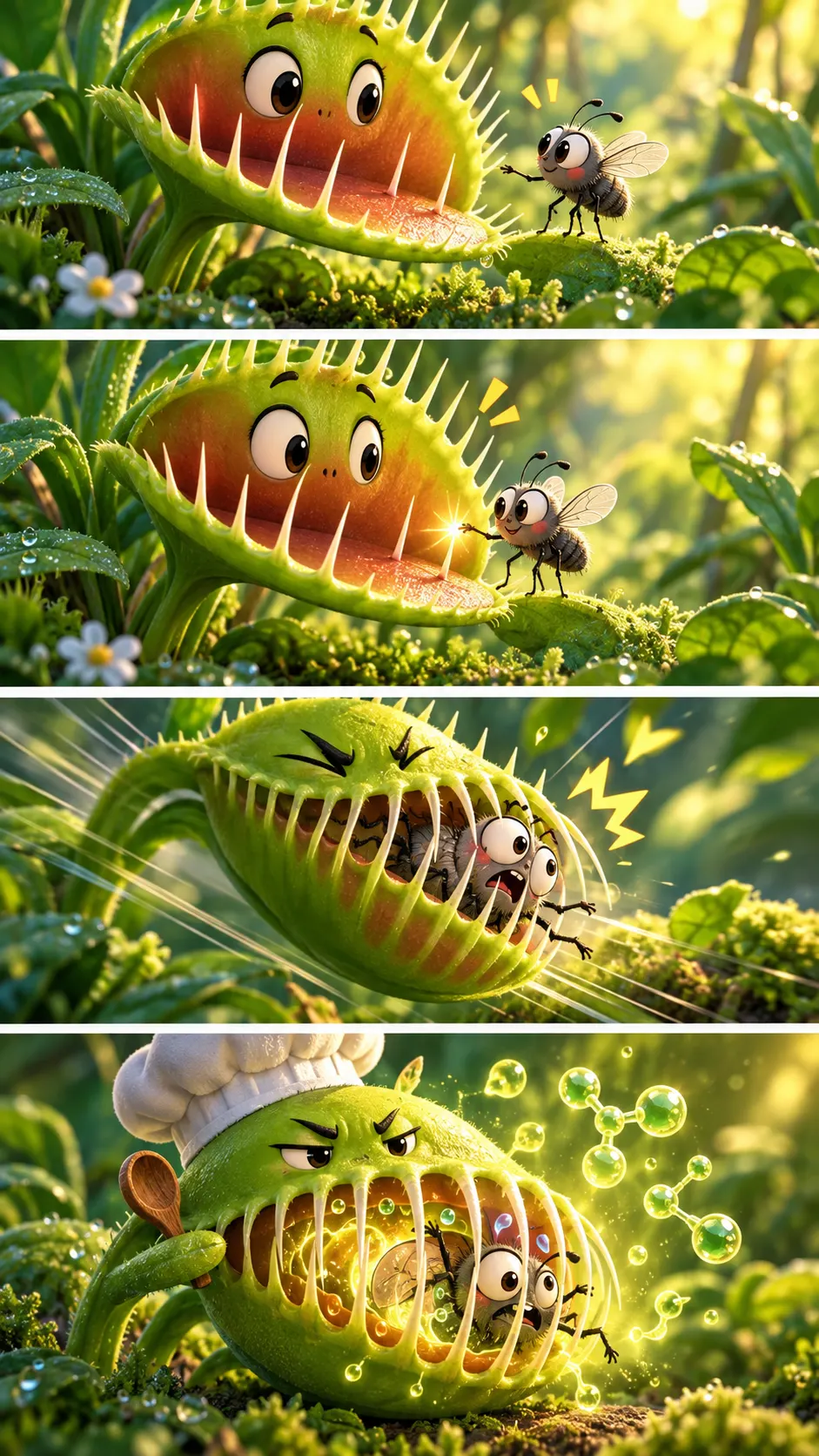
ハエトリグサは、葉の内側の毛を1回さわられただけでは閉じない。約30秒以内に2回目が来て初めてパクッ。閉じたあとも獲物が暴れて刺激が続くと、消化酵素の遺伝子が動き出す。脳のない植物が「回数」を数えている。
押すと「マジかリスト」に保存されます
 出典・参考文献(3件)タップで表示
- Böhm et al. (2016) The Venus Flytrap Dionaea muscipula Counts Prey-Induced Action Potentials to Induce Sodium Uptake, Current Biologydoi.org
- Suda et al. (2020) Calcium dynamics during trap closure visualized in transgenic Venus flytrap, Nature Plantsdoi.org
- Forterre et al. (2005) How the Venus flytrap snaps, Naturedoi.org

※本記事は上記の研究・公開資料をもとに、原田英語が独自の言葉で解説したものです。引用は著作権法第32条の範囲で行い、出典を明記しています。画像はすべてオリジナルのイメージです。研究結果には限界や個人差があります。誤りのご指摘は原田英語のお問い合わせフォームから。
 これも「マジか!?」


 動物・植物
動物・植物
脳がないのに1か月も「覚えていた」? オジギソウを何十回も落とした実験
 動物・植物
動物・植物
虫が「道具」でハチを釣っていた。ハチの樹脂を前脚に塗る“釣り師”サシガメの作戦

 動物・植物
動物・植物
「観葉植物で空気がキレイに」は幻想? 換気と同じ効果には1㎡に10〜1000鉢が必要だった
 動物・植物
動物・植物
ミツバチは「ゼロ」がわかる? 脳の小さな虫が「何もない」を数の一番下に置いた

 動物・植物
動物・植物
渡り鳥の目の中には「量子コンパス」が入っているかもしれない

 動物・植物
動物・植物