

 動物・植物ホント
夜の鳥ヨタカ、翼を「振り上げる」ときにも前へ進む力を出していた。風洞実験で判明
 2026.10.02
 English Corner(A2〜B2・4択クイズ)
 読む前に予想してみよう!
翼の振り上げで推進力を生む飛び方は、これまで主にコウモリやハチドリで知られていた
今回、ヨタカでも巡航中に翼の外側で推進力を生んでいることが分かった。
 研究カード(どんな研究?)
- 対象
- ヨーロッパヨタカ
- 規模
- 3羽(5羽捕獲し飛行可能な個体を選抜)
- 研究の種類
- 風洞での空力計測実験
- 確かさ
- ★★☆☆☆
スウェーデンの研究で、ヨタカは巡航中、翼を振り上げる動きでも推進力を生んでいた。コウモリやハチドリの特徴とされてきた現象。代わりに高速飛行の効率は低め。
ひとことで言うとヨタカは、つばさを上げるときもグイッと前に進んでいたんだ!
鳥が飛ぶしくみ、どう習いましたか? 「翼を振り下ろすときに空気をとらえて進み、振り上げるときは翼をたたんで空気抵抗を減らす」——多くの鳥ではそう考えられてきました。
ところが2026年9月30日、科学誌『PLOS Biology』に、スウェーデンのルンド大学のチームが、その常識をゆさぶる結果を発表しました。夜に虫を追う鳥ヨタカは、翼を振り上げるときにも前へ進む力(推進力)を生み出していたのです。
01「旅も、空中停止も」こなす欲張りな鳥
ヨーロッパヨタカは、アフリカとヨーロッパを行き来する長距離の渡り鳥。その一方で、エサの虫をとるときには、ゆっくり飛んだり、空中でホバリングしたりもします。
速く遠くへ飛ぶのと、ゆっくり器用に飛ぶのとでは、理想の翼の形が違います。両方をこなすヨタカは、空気力学的に「どこで折り合いをつけているのか」を調べるのにうってつけの鳥でした。
02発見1:巡航中の翼端に「二重のうず」
まず、ふつうの速さで飛んでいるとき、翼の先に2つのうずが並んでできる珍しい現象が見つかりました。
これは、翼が生み出す揚力の効率(翼幅効率)が下がっていることと関係していました。ヨタカの幅が広く、先が指のように分かれた翼は、ゆっくり飛ぶときの揚力には役立つ一方、速く飛ぶときには少しコストが高いようです。まさに「ホバリングの得意さ」と「巡航の効率」のトレードオフです。
03発見2:振り上げでも前に進む
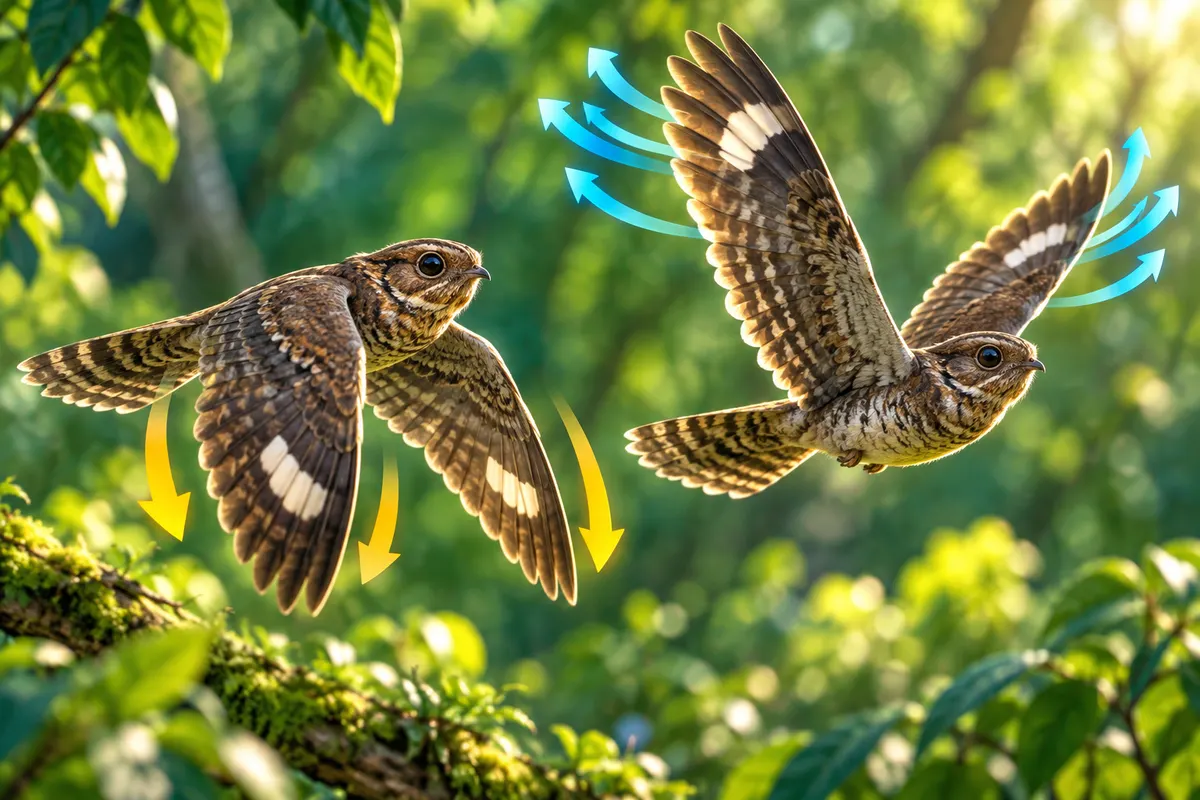
そしてもう一つが、翼の外側の部分が、振り上げのときに推進力を生んでいたこと。
この「振り上げで推進力」は、これまでコウモリやハチドリの特徴とされてきました。ハチドリは翼をくるりとひねって、振り上げでも体を支える力(揚力)を生むことが報告されています(Warrick et al., 2005)。
鳥の振り上げは、主に体重を支えるために使われると考えられてきたので、研究チームは「その考え方に疑問を投げかける結果」だとしています。
04なぜ振り上げで推進力が出るのか
動きを詳しく分析すると、ヨタカは振り上げのときに翼をあまり折りたためていないことが分かりました。翼をたためないなら、いっそその翼で空気を押してしまおう——そんな「制約から生まれた技」なのかもしれません。研究チームは、この関係が羽ばたき飛行に広く当てはまる可能性も指摘しています。
05まとめ
翼の形には、必ず「得意」と「苦手」があります。ヨタカは、速さを少しあきらめるかわりに、ゆっくり飛ぶ力と、振り上げでも進む技を手に入れていたのかもしれません。ドローンや小型飛行ロボットの設計にもヒントになりそうです。
この研究を英語で読もう原田英語の English CornerIn most birds, the downstroke of the wing produces the force that moves them forward, while the upstroke… 音声
音声 4択クイズ9問A2・B1・B2タップして開く
原田英語の English Corner
この研究を英語で読もう
Most birds move forward when they push their wings down. When they lift their wings up, they usually fold them.
But scientists in Sweden found something new. They flew three nightjars, birds that hunt insects at night, in a wind tunnel. The birds made forward power when they lifted their wings, too. Nightjars have wide wings. These wings are good for slow flight, but not for fast flight.
68 words ・ CEFR A2
和訳を見る
ほとんどの鳥は、翼を振り下ろすときに前へ進みます。翼を振り上げるときは、たいてい翼をたたみます。
しかし、スウェーデンの科学者たちは新しいことを発見しました。彼らは、夜に虫をとる鳥であるヨタカ3羽を風洞の中で飛ばしました。その鳥たちは、翼を振り上げるときにも前へ進む力を出していました。ヨタカは幅の広い翼を持っています。この翼はゆっくり飛ぶのには向いていますが、速く飛ぶのには向いていません。
4択リーディングクイズ
Q1. What is the passage mainly about?
ヨタカが翼を振り上げるときにも前へ進む力を出していた、という発見が中心なので C が正解。
Q2. How many nightjars flew in the wind tunnel?
They flew three nightjars とあるので A。
Q3. In this passage, "fold" means ...
fold は「折りたたむ」。翼を曲げて小さくすることなので D。
In most birds, the downstroke of the wing produces the force that moves them forward, while the upstroke mainly helps support their weight. However, researchers at Lund University in Sweden have found that European nightjars break this rule. Nightjars migrate long distances between Africa and Europe, but they also fly slowly and hover while catching insects.
The team flew three nightjars in a wind tunnel and studied the air behind their wings. During normal flight, the outer part of the wing produced forward thrust during the upstroke, something mainly known in bats and hummingbirds. Their broad wings, however, made fast flight less efficient, showing a trade-off between hovering ability and speed.
111 words ・ CEFR B1
和訳を見る
ほとんどの鳥では、翼の振り下ろしが前へ進む力を生み、振り上げは主に体重を支える助けをしています。しかし、スウェーデンのルンド大学の研究者たちは、ヨーロッパヨタカがこのルールを破っていることを発見しました。ヨタカはアフリカとヨーロッパの間を長距離移動しますが、虫をとるときにはゆっくり飛んだりホバリングしたりもします。チームは3羽のヨタカを風洞で飛ばし、翼の後ろの空気を調べました。
ふつうの飛行中、翼の外側の部分が振り上げのときに推進力を生んでいました。これは主にコウモリやハチドリで知られてきたことです。しかし、その幅の広い翼は速く飛ぶ効率を下げており、ホバリングの能力と速さの間のトレードオフを示していました。
4択リーディングクイズ
Q1. What "rule" do nightjars break?
直前の文で、多くの鳥では振り下ろしが前進の力、振り上げは主に体重支持と説明しているので B。
Q2. Which animals were already known to produce thrust during the upstroke?
something mainly known in bats and hummingbirds とあるので D。
Q3. What does "a trade-off" between hovering ability and speed mean here?
幅の広い翼はホバリングに有利だが速く飛ぶ効率を下げる。一方を得ると他方を失う関係なので C。
Textbook accounts of bird flight hold that the downstroke generates thrust, while the upstroke, with the wing folded to reduce drag, mainly contributes to weight support. A study published in PLOS Biology by researchers at Lund University challenges this view. European nightjars are an ideal test case because they combine long-distance migration between Africa and Europe with slow, maneuverable flight and hovering when hunting insects, activities that favor different wing shapes. The team selected three wild nightjars able to fly at a range of speeds, flew them in a wind tunnel, visualized the wake behind their wings and analyzed wing motion in three dimensions before releasing the birds.
At cruising speeds, the researchers observed an unusual pair of vortices at each wingtip, associated with reduced aerodynamic efficiency; the broad, slotted wingtips seem to aid slow flight but carry a cost at higher speeds. More surprisingly, the outer wing produced thrust during the upstroke, a feature previously attributed mainly to bats and hummingbirds. Because the birds could not fold their wings much during the upstroke, the authors suggest this restriction may underlie the extra thrust. With only three birds tested in an artificial setting, however, the findings need confirmation.
198 words ・ CEFR B2
和訳を見る
鳥の飛行についての教科書的な説明では、振り下ろしが推進力を生み、振り上げは抵抗を減らすために翼をたたみ、主に体重を支える役割を担うとされています。ルンド大学の研究者が『PLOS Biology』に発表した研究は、この見方に疑問を投げかけています。ヨーロッパヨタカは理想的な検証対象です。アフリカとヨーロッパの間の長距離の渡りと、虫をとるときのゆっくりとした機敏な飛行やホバリングという、異なる翼の形が有利になる活動をあわせ持っているからです。チームは、さまざまな速さで飛べる野生のヨタカ3羽を選んで風洞で飛ばし、翼の後ろの気流を可視化し、翼の動きを3次元で解析したあと、鳥を放しました。巡航速度では、研究者たちはそれぞれの翼の先に珍しい一対のうずを観察し、それは空気力学的な効率の低下と関連していました。
幅が広く切れ込みのある翼の先は、ゆっくり飛ぶのには役立つものの、高速ではコストがかかるようです。さらに驚くべきことに、翼の外側は振り上げのときに推進力を生んでいました。これは以前は主にコウモリやハチドリの特徴とされていたものです。鳥たちは振り上げの間に翼をあまりたためなかったため、著者らはこの制約が追加の推進力の背景にあるのかもしれないと述べています。ただし、人工的な環境で3羽しか調べていないため、結果には確認が必要です。
4択リーディングクイズ
Q1. Why are nightjars described as "an ideal test case"?
長距離の渡りと、ゆっくりした飛行・ホバリングという異なる翼の形が有利な活動を両立しているから。A が正解。
Q2. What did the researchers observe at cruising speeds?
At cruising speeds, the researchers observed an unusual pair of vortices at each wingtip とあるので C。翼はあまりたためなかったので B は逆。
Q3. What do the authors suggest may explain the upstroke thrust?
Because the birds could not fold their wings much ... this restriction may underlie the extra thrust とあるので B。
重要単語
- upstrokeC1名詞(翼の)振り上げSome birds produce thrust during the upstroke.
 up+stroke(ひとかき・一振り)。対になるのは downstroke(振り下ろし)。水泳の stroke と同じ語。
 - thrustC1名詞・動詞推進力/ぐいと押すThe engine produces thrust. 物理・航空では lift(揚力)、drag(抗力)、thrust(推進力)、weight(重力)の4つの力をセットで覚える。
- hoverB2動詞空中で静止する、ホバリングするHummingbirds can hover in front of flowers. hover around 50%「50%前後を推移する」のように数値の比喩でも使われる。
- vortexC1名詞うずA vortex forms at the tip of the wing. 複数形は vortices(ヴォーティシーズ)または vortexes。ラテン語系の複数形 -ices に注意。
- trade-offC1名詞あちらを立てればこちらが立たない関係There is a trade-off between speed and control. a trade-off between A and B の形で使う。動詞句 trade A off against B も同じ発想。
- efficientB1形容詞効率のよいLong, narrow wings are efficient for fast flight. 名詞 efficiency。effective(効果的な)との区別が入試で狙われる。
- migrationB2名詞(鳥の)渡り、移動Nightjars make a long migration between Africa and Europe. 動詞 migrate。migratory bird(渡り鳥)も覚えておく。
 入試に出る順の単語帳を印刷する →
 全5561語の「科学英単語カード」で復習する →
このネタ、誰かに教えたくなった?
鳥は翼を振り下ろして進み、振り上げは休憩…という常識が覆るかも。風洞でヨタカを飛ばしたら、振り上げでも前へ進む力を出していたらしい。コウモリやハチドリの得意技とされてきたもの。代わりに速く飛ぶのは少し苦手。
押すと「マジかリスト」に保存されます
 出典・参考文献(3件)タップで表示
- Johansson et al. (2026) Nightjars trade off cruising speed efficiency for hovering capabilities and link upstroke thrust production with restricted wing folding, PLOS Biologydoi.org
- Warrick, Tobalske & Powers (2005) Aerodynamics of the hovering hummingbird, Naturedoi.org
- Hedenström et al. (2007) Bat Flight Generates Complex Aerodynamic Tracks, Sciencedoi.org

※本記事は上記の研究・公開資料をもとに、原田英語が独自の言葉で解説したものです。引用は著作権法第32条の範囲で行い、出典を明記しています。画像はすべてオリジナルのイメージです。研究結果には限界や個人差があります。誤りのご指摘は原田英語のお問い合わせフォームから。
 これも「マジか!?」
 動物・植物
動物・植物
虫が「道具」でハチを釣っていた。ハチの樹脂を前脚に塗る“釣り師”サシガメの作戦

 動物・植物
動物・植物
猫のおしっこには「名刺」が入っていた。腎臓にためた脂肪酸で“自分”を名乗る

 動物・植物
動物・植物
チョウの派手な翅は「動くだまし絵」だった。羽ばたくと鳥の目を狂わせる錯覚が生まれる
 動物・植物
動物・植物
カエルも「多すぎて選べない」。オスの声が8つになると、迷った末に決めない回数が約5倍に

 動物・植物
動物・植物
動物の誕生は8億〜7億年前?「化石がない=まだいない」という前提がモンゴルで揺らいだ
 動物・植物
動物・植物