宇宙・NASAホント
死んだ星を生きのびた「木星」がいた。ウェッブ望遠鏡が見た“50億年後の太陽系”の予告編
 2026.10.03
 English Corner(A2〜B2・4択クイズ)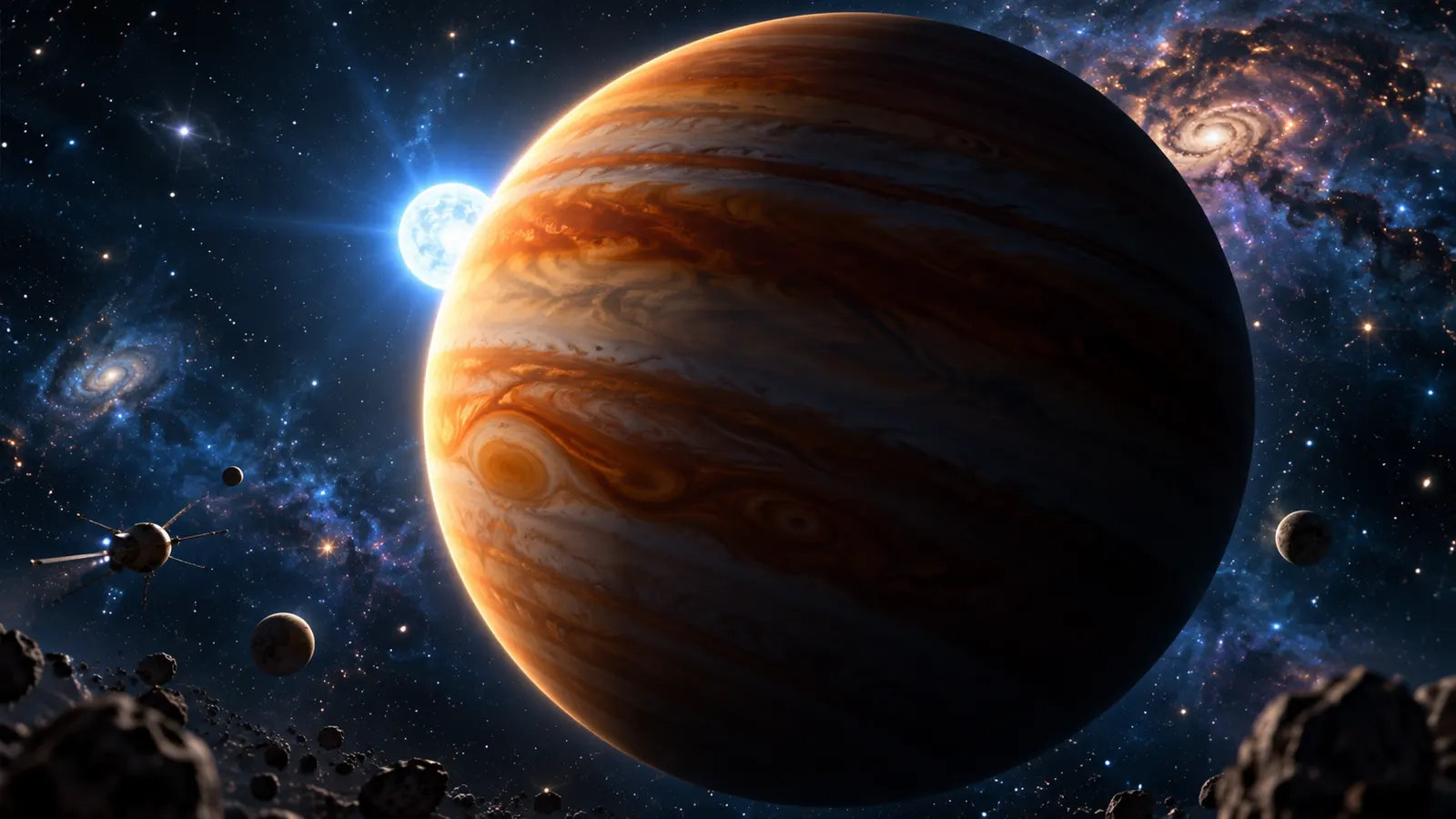
 読む前に予想してみよう!
太陽のような星が一生を終えると、まわりの惑星はすべて必ず消えてしまう
星の最期を生きのびて、燃えつきた星(白色矮星)を回り続ける巨大惑星が実際に見つかっている。
 研究カード(どんな研究?)
- 対象
- 白色矮星WD 1856+534を回る巨大惑星
- 規模
- 惑星1個
- 研究の種類
- 宇宙望遠鏡による分光観測(トランジット法)
- 確かさ
- ★★★☆☆
燃えつきた星「白色矮星」のすぐそばを回る木星サイズの惑星を、ウェッブ望遠鏡が詳しく観測。星の死を外側で生きのび、数十億年後に内側へ移ってきたらしい。
ひとことで言うと星が死んだあとも、そのまわりで生きのこった大きな惑星がいたよ!
太陽はいつか死にます。およそ50億年後、燃料を使い果たした太陽は大きくふくらみ、最後は地球ほどの大きさの燃えかすになると考えられています。
そのとき、木星や土星はどうなるのでしょう? ふつうは確かめようがありません。50億年も待てないからです。
ところが約80光年先に、その「答え」に近いものがありました。すでに死んだ星のすぐそばを回る、木星サイズの惑星です。2026年7月、ジェイムズ・ウェッブ宇宙望遠鏡でこの惑星を詳しく調べた研究が、科学誌『Nature』に発表されました。
01「いるはずのない場所」にいる惑星
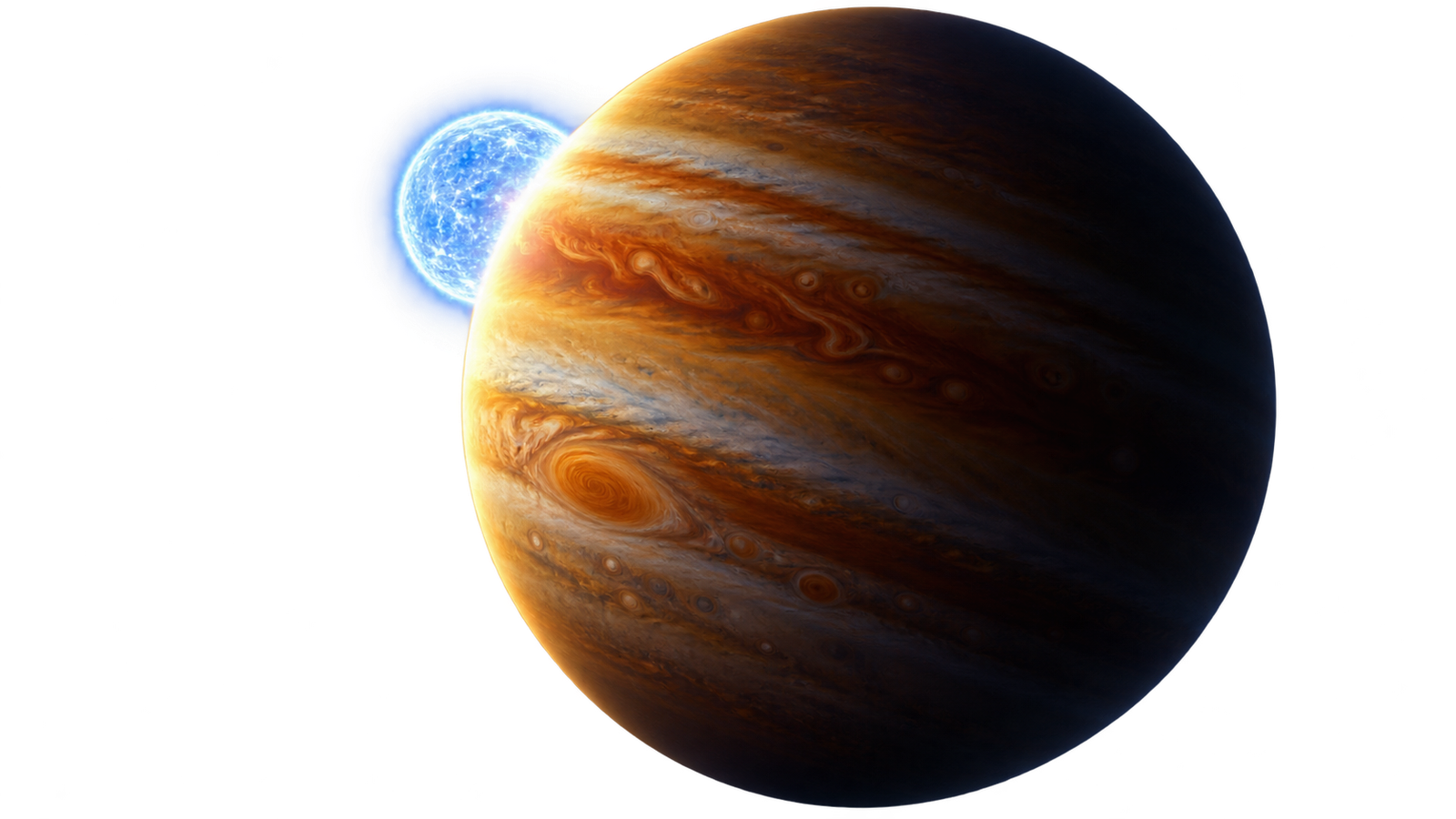
この惑星の名前は WD 1856 b。りゅう座の方向にある白色矮星「WD 1856+534」を回っています。2020年に、NASAの系外惑星探査衛星TESSなどによって見つかりました。
白色矮星とは、太陽くらいの星が一生を終えたあとに残る芯のような天体です。この白色矮星は地球より少し大きい程度。一方、惑星は木星ほどあるので、惑星のほうが星より7倍ほど大きいという、なんとも不思議な組み合わせです。
さらにおかしいのは距離。この惑星は、地球と太陽の距離の約50分の1というすぐそばを、わずか34時間ほどで1周しています。
星は死ぬ前に、赤色巨星として何百倍にもふくらみます。その時期にこんな近くにいたら、惑星は飲みこまれていたはず。だからこの領域は「禁断ゾーン」とも呼ばれています。WD 1856 bは、その禁断ゾーンで見つかった惑星なのです。
02余分な熱が「引っ越しの記録」だった
なぜこんなに温かいのか。いまの惑星を温め続けるような熱源は見当たりません。そこでチームは、これは過去に温められた熱の“残り”だと考えました。
巨大な惑星が時間とともに冷えていく計算モデルに、ウェッブで測った質量と温度を当てはめ、時間を巻き戻します。すると、惑星が強く温められたのは、星が白色矮星になってから30億〜55億年後という答えが出ました。
ここから浮かぶシナリオはこうです。惑星はもともと遠い軌道にいて、星がふくらむ危険な時期を無事にやりすごした。その後、何十億年もたってから内側へ引っ越してきた。近づく途中で、白色矮星の強い重力にもまれて熱くなり、それからゆっくり冷えてきた——というわけです。
この白色矮星は、遠くに2つの赤色矮星をしたがえた三つ子の星の一員です。その重力のいたずらが、惑星の軌道をゆさぶったのかもしれません。

03どんでん返し:温度の見積もりはまだ揺れている
実は2025年、ほぼ同じ研究者グループを含むチームが、ウェッブの中間赤外線カメラで同じ惑星の光をとらえ、温度を約マイナス87℃と見積もっていました。「光を直接とらえた系外惑星としては最も冷たい」と報告されたのです。
2026年の結果とは、200℃以上の差があります。測り方(どの波長の光を、どんな方法で測ったか)が違うため、どちらが正しいかはまだ決着していません。チームはすでに追加で4回のトランジットを観測しており、続報が待たれます。
04まとめ
WD 1856 bは、星の最期を遠くでやりすごし、何十億年もたってから戻ってきた「生存者」でした。
太陽も約50億年後には赤色巨星になり、水星や金星、もしかすると地球も飲みこまれると考えられています。でも、遠くを回る木星のような惑星には、その先の物語があるのかもしれません。80光年先の惑星は、私たちの太陽系の“遠い未来の予告編”なのです。
この研究を英語で読もう原田英語の English CornerIn about five billion years, our Sun will swell into a red giant and later shrink into a white dwarf. 音声
音声 4択クイズ9問A2・B1・B2タップして開く
原田英語の English Corner
この研究を英語で読もう
Stars like our Sun die one day. They grow very big and then become small, dead stars called white dwarfs. About 80 light-years away, there is a planet as big as Jupiter near a white dwarf. It goes around the star in about 34 hours.
Scientists used the Webb telescope to study it. The planet is warmer than they expected. They think it moved close to the star billions of years after the star died.
75 words ・ CEFR A2
和訳を見る
私たちの太陽のような星は、いつか死にます。とても大きくなり、そのあと白色矮星と呼ばれる小さな死んだ星になります。約80光年先に、白色矮星の近くに木星ほどの大きさの惑星があります。それは約34時間で星のまわりを回ります。
科学者たちはウェッブ望遠鏡を使ってそれを調べました。惑星は予想より温かいです。彼らは、星が死んでから何十億年もあとに、惑星が星の近くへ移動したと考えています。
4択リーディングクイズ
Q1. What is the passage mainly about?
白色矮星(死んだ星)の近くを回る惑星の話なので B。
Q2. How long does the planet take to go around the star?
It goes around the star in about 34 hours とあるので A。
Q3. What does "expected" mean in the passage?
expect は「予想する」。warmer than they expected で「予想より温かい」なので C。
In about five billion years, our Sun will swell into a red giant and later shrink into a white dwarf. What will happen to the planets? Astronomers found a clue about 80 light-years away. A Jupiter-sized planet called WD 1856 b orbits a white dwarf that is only about the size of Earth. It is so close that it goes around in about 34 hours.
When the star was a red giant, a planet this close would have been swallowed. Using the James Webb Space Telescope, a team found that the planet is about 126 degrees Celsius, much warmer than expected. Their models suggest it was heated when it moved inward billions of years after the star died.
118 words ・ CEFR B1
和訳を見る
約50億年後、太陽はふくらんで赤色巨星になり、のちに縮んで白色矮星になる。惑星はどうなるのだろうか。天文学者たちは約80光年先に手がかりを見つけた。WD 1856 bと呼ばれる木星サイズの惑星が、地球ほどの大きさしかない白色矮星を回っているのだ。それはとても近く、約34時間で1周する。
星が赤色巨星だったとき、これほど近い惑星は飲みこまれていたはずだ。ジェイムズ・ウェッブ宇宙望遠鏡を使い、あるチームは、その惑星が約126℃で、予想よりずっと温かいことを発見した。彼らのモデルによれば、惑星は星が死んで何十億年もたってから内側へ移動したときに温められたらしい。
4択リーディングクイズ
Q1. How big is the white dwarf in the passage?
a white dwarf that is only about the size of Earth とあるので C。
Q2. Why is the planet's position surprising?
a planet this close would have been swallowed とあるので A。
Q3. What can we infer from the planet's high temperature?
温度が高いのは、星の死後に内側へ移動したときに温められたためだとモデルが示しているので B。
Stars like the Sun end their lives by expanding into red giants and then collapsing into white dwarfs, dense remnants roughly the size of Earth. Any planet orbiting too close during the red giant phase should be engulfed, which makes WD 1856 b, a Jupiter-sized planet circling a white dwarf every 34 hours, something of a puzzle. In a 2026 Nature paper, an international team used the James Webb Space Telescope to observe the planet as it passed in front of its star. They detected hydrocarbons, most likely methane, along with small cloud particles, making this the first atmosphere identified on a planet transiting a dead star. They also estimated its temperature at around 400 kelvins, far above the roughly 160 kelvins expected from starlight alone.
By combining this temperature with cooling models, they concluded that the planet was reheated three to five and a half billion years after the star became a white dwarf, probably as it migrated inward. An earlier Webb study, though, had reported a temperature near 186 kelvins, and the two measurements have yet to be reconciled. A single planet is also a thin basis for general conclusions.
192 words ・ CEFR B2
和訳を見る
太陽のような星は、膨張して赤色巨星になり、そのあと崩れて白色矮星という、地球ほどの大きさの高密度な残骸になって一生を終える。赤色巨星の時期に近すぎる軌道を回る惑星は飲みこまれるはずであり、34時間ごとに白色矮星を回る木星サイズの惑星WD 1856 bは、一種の謎となっている。2026年のNature誌の論文で、国際チームはジェイムズ・ウェッブ宇宙望遠鏡を使い、惑星が星の前を通過するところを観測した。彼らは小さな雲の粒子とともに、炭化水素、おそらくメタンを検出し、これは死んだ星の前を通過する惑星で初めて確認された大気となった。彼らはまた、その温度を約400ケルビンと見積もった。これは星の光だけから予想される約160ケルビンをはるかに上回る。
この温度を冷却モデルと組み合わせることで、彼らは、惑星が星が白色矮星になってから30億〜55億年後に、おそらく内側へ移動する際に再加熱されたと結論づけた。ただし、以前のウェッブの研究では約186ケルビンという温度が報告されており、2つの測定結果はまだすり合わされていない。また、1つの惑星だけでは一般的な結論を導くには根拠が薄い。
4択リーディングクイズ
Q1. Why is WD 1856 b described as "something of a puzzle"?
赤色巨星の時期に近すぎる惑星は飲みこまれるはずなのに、すぐ近くを回っているため A。
Q2. What did the team detect in the planet's atmosphere?
They detected hydrocarbons, most likely methane, along with small cloud particles とあるので B。
Q3. What is the author's attitude toward the conclusions?
温度の測定値に食い違いがあり、1つの惑星だけでは一般的な結論の根拠として薄いと述べているので C。
重要単語
- white dwarfC1名詞(句)白色矮星Our Sun will become a white dwarf in the far future.
 dwarf は「小人、小さいもの」。red dwarf(赤色矮星)、brown dwarf(褐色矮星)も合わせて。
 - red giantC1名詞(句)赤色巨星A red giant can swallow nearby planets. giant「巨人、巨大なもの」。星の一生(life cycle of stars)の長文で必ず出る。
- engulfC1動詞飲みこむ、包みこむThe dying star could have engulfed the planet. en-(中に)+gulf(深い穴)。be engulfed in flames「炎に包まれる」も頻出。
- migrateB2動詞移動する、移住するThe planet migrated inward billions of years later. 名詞は migration。鳥の渡りや人の移住にも、惑星の軌道移動にも使える。
- remnantC1名詞残り、残骸A white dwarf is the remnant of a dead star. supernova remnant「超新星残骸」。remain(残る)と同じ語源。
- transitB2名詞・動詞通過(惑星が星の前を横切ること)Astronomers watched the planet's transit across the star. 日常では public transit「公共交通機関」。天文学では「トランジット法」で系外惑星を探す。
- reconcileC1動詞(食い違いを)調整する、一致させるScientists need to reconcile the two temperature measurements. reconcile A with B「AとBを両立させる」。「仲直りさせる」の意味もある難関大頻出語。
 入試に出る順の単語帳を印刷する →
 全5633語の「科学英単語カード」で復習する →
 公式・一次情報をチェック
 4コマでわかる
このネタ、誰かに教えたくなった?
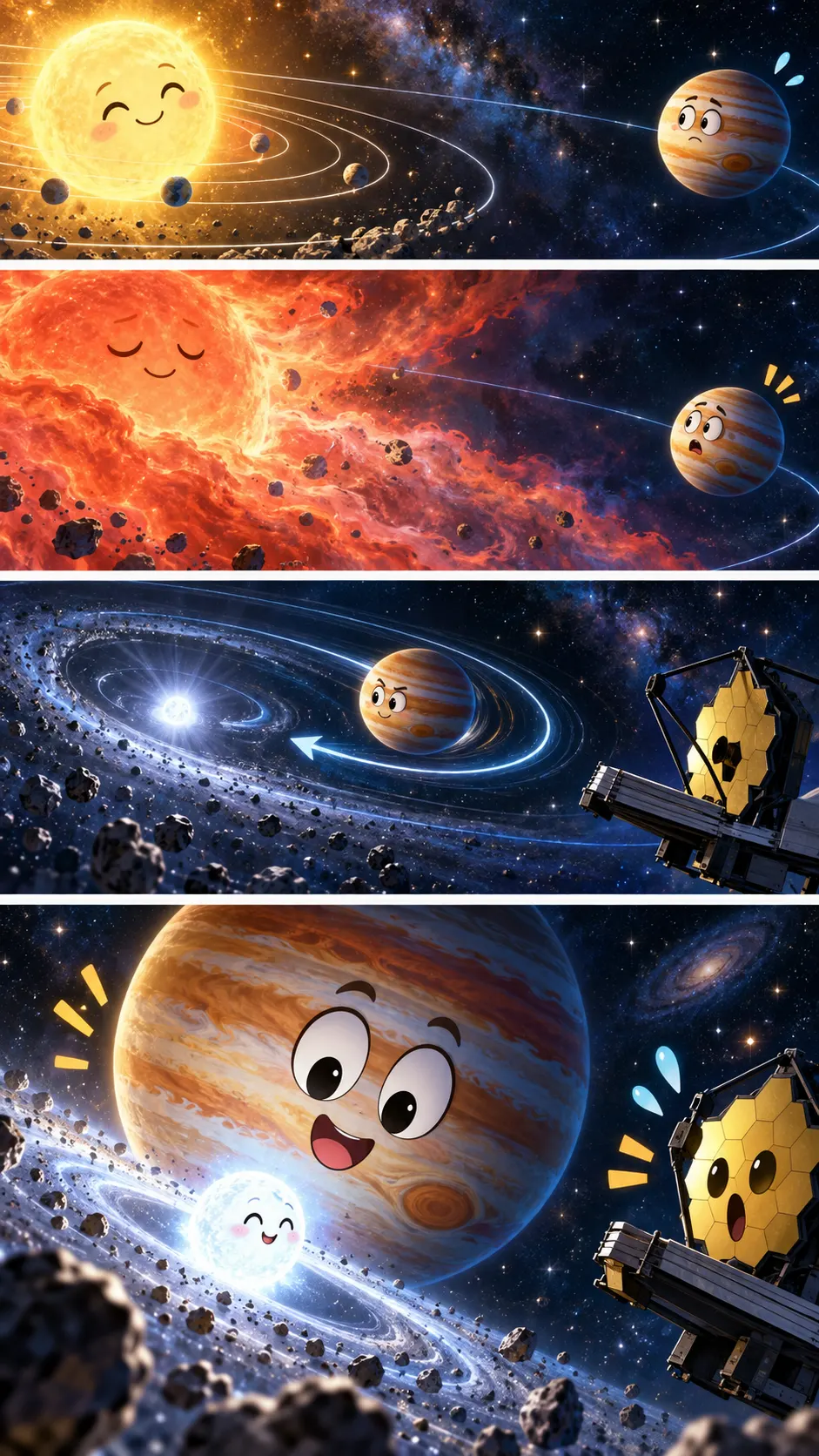
80光年先に、燃えつきた星のすぐそばを34時間で回る木星サイズの惑星がある。本来なら星の最期に飲みこまれる場所。ウェッブ望遠鏡で調べたら、星の死から数十億年後に内側へ引っ越してきたらしい。太陽系の未来の予告編かも。
押すと「マジかリスト」に保存されます
 出典・参考文献(4件)タップで表示
- MacDonald et al. (2026) Aerosols and hydrocarbons in the atmosphere of a white dwarf planet, Naturedoi.org
- Limbach et al. (2025) Thermal Emission and Confirmation of the Frigid White Dwarf Exoplanet WD 1856+534 b, The Astrophysical Journal Lettersdoi.org
- Vanderburg et al. (2020) A giant planet candidate transiting a white dwarf, Naturedoi.org
- Schröder & Connon Smith (2008) Distant future of the Sun and Earth revisited, Monthly Notices of the Royal Astronomical Societydoi.org

※本記事は上記の研究・公開資料をもとに、原田英語が独自の言葉で解説したものです。引用は著作権法第32条の範囲で行い、出典を明記しています。画像はすべてオリジナルのイメージです。研究結果には限界や個人差があります。誤りのご指摘は原田英語のお問い合わせフォームから。